In fact, according to the research, after one day people remember 68% of stories but only 27% of statistics.
Ever sat through a technical presentation and thought, “Wow, that was…uninspiring?” If your team struggles with this, you’re not alone. That’s exactly why storytelling training for technical teams has become essential for engineers, analysts, and research professionals.
If your team’s data is failing to drive action, it’s not because of the content.
It’s because nobody taught them how to tell a persuasive story.
If you’d like to discuss customized training for your team, go here.
Here’s Why Teams Struggle with Technical Presentations
Most technical professionals aren’t trained as storytellers.
They’re taught to report facts, not guide their audience on a compelling journey.
But here’s the secret:
Humans remember stories, not statistics.
When your team can transform technical information into a meaningful narrative, everything changes: funding gets approved, stakeholders buy in, and change becomes easier with the right story (research).
Your team probably has:
✓ Strong technical expertise
✓ Solid data and research
✓ Important findings to share
But they’re likely missing:
✗ A framework for engaging audiences
✗ Confidence presenting to executives and decision-makers
✗ The ability to make complex information memorable
When technical professionals don’t know how to tell their story, good ideas die in conference rooms.
The 5-Step Framework that Works
After more than a decade supporting technical professionals, engineers, and analysts, I’ve developed a five-step tech presentation training framework proven to help teams transform technical information into persuasive presentations.
Step #1. Open with a Question, Not Data
Every compelling technical presentation begins with a genuine question or challenge – not with data or methodology. This primes your audience’s curiosity and signals that you’re taking them on a journey to find an answer.
Open with a genuine problem your audience cares about, not data.
-
✗ “We analyzed retention data”
-
✓ “Why do 40% of our customers leave in year one?”
Here’s an example of how Dan Gartenberg, in his TED Talk, hooks the audience into his talk with a question:
Ask yourself: What’s the core question your team is trying to answer? Frame it in human terms, not technical jargon. This becomes your opening hook.
Step #2. Put Real People in Your Story
Bring your research or project to life by humanizing it.
Instead of abstract descriptions, introduce the people involved and why the problem matters.
-
✗ “A study was conducted”
-
✓”Our head of customer success, Priya, noticed something troubling: high-value customers were leaving silently. She wasn’t sure why.”
Highlight the main character. Just one human detail can make a big difference.
Step #3. Build Suspense with the Journey
Don’t rush through methodology. Instead, walk your audience through the journey as if you’re unfolding a mystery.
Here’s an example of how to do it right:
“The researchers designed their study carefully.
They recruited 150 participants who struggled with high LDL cholesterol. They divided them into two groups randomly:
Group one received 10.5 grams of fiber supplement daily.
Group two received a placebo that looked identical.
Neither group knew which they were taking.
Both had their cholesterol measured at the start.
Then came the hardest part: waiting.
Twenty-six weeks passed.
Participants tracked their diet, took their daily dose, and returned for check-ins.
So, what did the data show?”
Notice how sharing the journey behind the research hooks you right in? Let your audience follow the research discovery with you.
Ray Kuzweil does this really well in his talk (starting @ 3:54):
The process is the story, so don’t neglect it.
Resource: Tell stories like the best TED speakers
Step #4. Reveal the Results with Context
Now you deliver the payoff – the results that your audience came for.
Here’s a quick look at how to do it incorrectly, and then how to do it right:
- ✗ “Results showed an 18% improvement”
- ✓ “At week 26, the results came back. The placebo group’s cholesterol remained essentially unchanged—right where they started. But the supplement group saw something striking: an average 18% reduction in LDL cholesterol.”
Connect the findings directly back to the opening question.
Step #5. End with A Clear Recommendation
Unfortunately, too many presenters let their presentations die with a weak conclusion.
Ever heard someone end their presentation with something like this?
-
✗ “In conclusion…yeah, those are the findings.”
Don’t be that person!
Instead, have the confidence to make a clear recommendation. Suggest the next steps based on your interpretation of the data.
Example:
✓ “This insight changes how we think about retention.
Instead of trying to re-engage churning customers, we need to focus on the first week.
Here’s my first recommendation:
We should focus on the first week of the customer onboarding journey because that’s where retention is won or lost. Specifically, we could try…”
Want a perfect example of someone who does all this really well?
Look no further than Hans Rosling.
When giving a technical presentation, ask yourself: What does your finding mean for your audience?
What should they do with this information?
Give them a concrete next step and a clear way to engage.
The Workshop: 4 Core Modules For Technical Presentation Mastery
Of course, there’s a lot more to it than what I’ve shared in the article.
In my corporate workshops, we dive into 4 core modules.
These are:
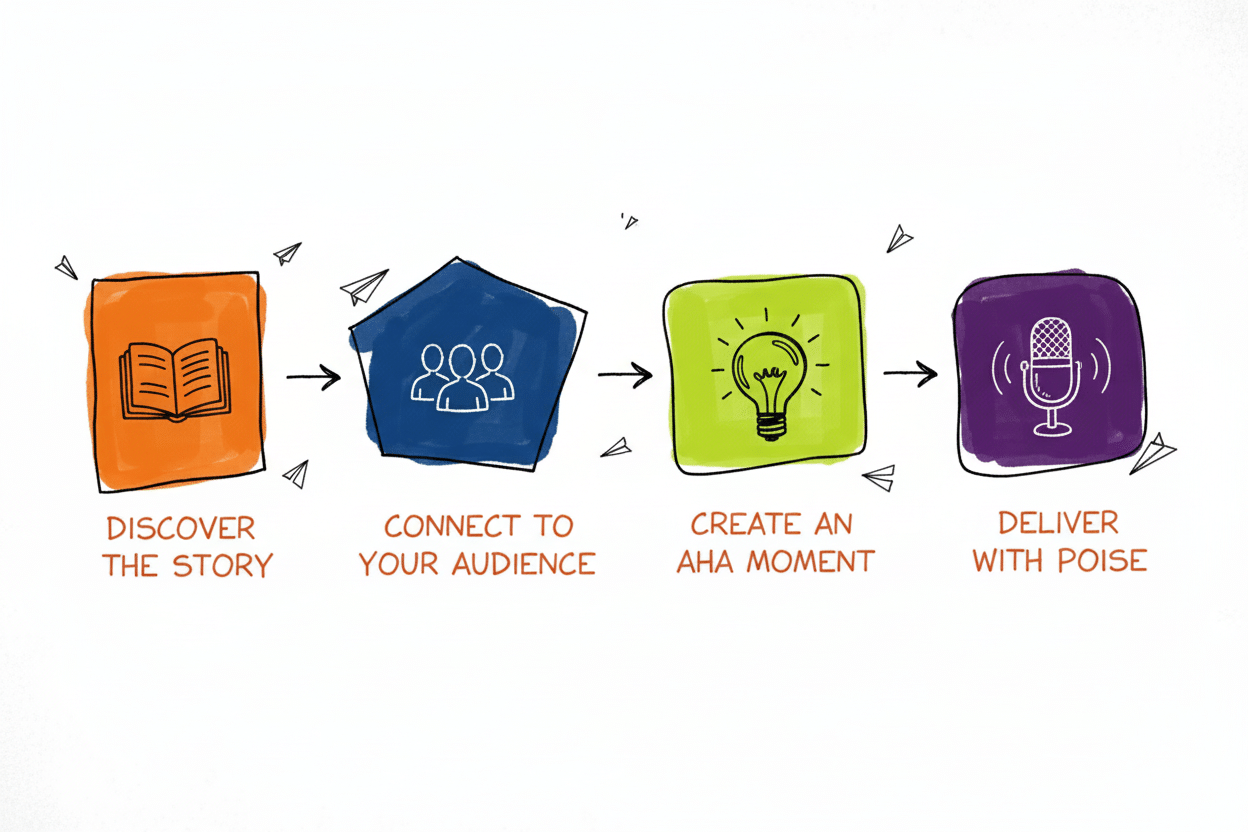
Module 1: Discover the Story
- Identify the core message hidden in your data
- Simplify complex concepts into narratives anyone can follow
- Frame technical information in ways that align with executive and client priorities
Module 2: Connect to Your Audience
- Highlight the “so what” that connects your insights to business priorities
- Adapt your narrative style for technical vs. non-technical audiences
- Anticipate objections and weave in supporting evidence that builds trust
Module 3: Create an Aha Moment
- Make insights memorable with storytelling techniques and narrative arcs
- Avoid common presentation mistakes that kill most technical pitches
- Create “aha” moments that move stakeholders to act
Module 4: Deliver with Poise
- Present your technical story with confidence, poise, and authority
- Handle tough questions, objections, or scrutiny with composure
- Combine clarity, conviction, and executive presence to create winning stories
What You Can Expect From the Training
Having worked with engineers, data analysts, and researchers, I’ve seen firsthand how the right storytelling training for technical teams makes presentations engaging and memorable.”
During the live storytelling workshop, your team will get:
-
Hands-on practice in turning raw data into engaging stories
-
Tailored exercises for scientific, engineering, or business presentations
-
Real-time coaching that builds skills in executive and stakeholder engagement
-
Frameworks for communicating technical concepts clearly and confidently
-
Boosted confidence presenting to any audience
A Self-Assessment: Is Your Team’s Communication Effective?
Ask yourself:
- Do your team’s technical presentations often get overlooked or forgotten soon after the meeting?
- Are stakeholders or decision-makers failing to see the true impact of your team’s work?
- Do team members feel anxious or lose confidence when presenting to high-level executives or external audiences?
- Are great ideas or valuable research stalling because they aren’t communicated clearly?
- Does your team struggle to make complex information clear and memorable for non-technical listeners?
If you nodded yes to even one, your team stands to gain a lot from our in-depth and focused storytelling training for technical teams.
Ready to Level Up Your Team’s Technical Presentations?
If you want to explore this for your team, let’s talk.
Schedule a free consultation, and we’ll discuss what would work best for your group.
Schedule a free consultation here.
FAQs:
Q: Will this technical storytelling training work for our engineers, analysts or researchers?
A: Absolutely. Technical professionals excel once they can translate logical data into a story arc. This technical storytelling training gives engineers, scientists, analysts, and developers proven techniques for communicating technical ideas and making any presentation – research findings, product demos, or executive briefings – clear, memorable, and persuasive.
Q: Is this just public speaking training?
A: No, this program is focused on structuring complex information as a clear, memorable story. While public speaking skills are helpful (and will be partly covered), the focus is on mastering the art of storytelling.
Q: What types of presentations are covered?
A: The training applies to research findings, project pitches, R&D briefings, technical sales demos, product launches, internal updates, and executive presentations. Essentially any setting where technical information needs to drive some kind of action.
Q: Is the workshop offered virtually, on-site, or both?
A: We deliver workshops both on-site and virtually, making it easy to accommodate distributed or international teams.
Q: How interactive is the training? Will our team get to practice?
A: The workshop is hands-on and interactive. Your team will learn by doing .. through tailored exercises, live feedback, and real practice with their own presentation topics. Clients say that these workshops are some of the best they’ve ever attended, partly because of how hands-on and practical they are.
Q: How long are the workshops, and how many people can join?
A: We offer flexible formats from 60-minute intensives to half-day workshops, for teams of any size. Contact us to discuss the best fit for your group.
Q: What outcomes can we expect after training?
A: Teams consistently report higher confidence, improved stakeholder engagement, stronger business outcomes, and presentations that are remembered and acted upon.
Q: Are there any tools or takeaways included?
A: Yes. Participants get exclusive access to storytelling templates, checklists, and presentation frameworks they can use for future technical talks.
Q: Why book Akash for storytelling training?
A: A former introvert turned global communication keynote speaker, Akash has been ranked one of the top 10 communication experts in the world (Global Gurus, 2025). Akash’s workshops are known for their energy, relevance, and immediate takeaways. You and your team will be involved from start to finish, leaving inspired and equipped to tell stories that matter.