

In this guide, we’ll explore how to build executive presence.
We’ll explore: what is executive presence, why does it matter and how do you develop it?
The good news is that executive presence is a learnable skill.
Key Takeaways:
- Executive presence starts before you say a word. The way you stand, the way you move, and how you hold yourself in a room all send a message. Stand tall. Own your space. And dress like someone worth paying attention to.
- Great leaders don’t rush their words. They pause. They let their points land. They know when to slow down for impact and when to pick up the pace to build excitement. Your voice is your tool—use it intentionally.
- True confidence can’t be faked. It comes from knowing your stuff, making smart decisions, and staying calm under pressure. The more you build your expertise, the more people will trust you to lead.
- Executive presence = composure. A large part of executive presence is emotional regulation. Recognize your feelings, but don’t let them dictate your actions. Practice staying composed, and you’ll earn respect when it matters most.
- Executive presence doesn’t mean hogging the spotlight. Stop trying to prove how smart you are. Stop hogging the spotlight. Listen. Ask better questions. Share your why. When people feel connected to you, they’ll want to follow you.
In the article below, we’ll go into detail on each one of these tools to help you develop your executive presence. Let’s dive into it…
Table of Contents
- Key Takeaways:
- The Two Elements of Executive Presence
- How To Build Executive Presence: 12 Tactics
- 1. Speak deliberately: Own the room
- When you slow down, you signal your confidence and composure
You’re signaling to the room: “I’m confidence. I’m calm. I’m in control.” These are key aspects of executive and leadership presence.Now, I recognize that this is hard to do, and takes practice.
In fact, I remember my own early days of speaking. I rushed through my words, trying to get everything out as quickly as possible. Silence seemed scary!
But, it’s something I’ve gotten much at better at through by being more conscious of.
Want to see this in action?
Watch how Ramit helps this woman slow down.
Notice how she comes across as more composed and confident when she isn’t rushing through what she’s saying:
If you struggle with this, consider working with a coach. I can help
2. Embrace the full range of your voice - Master your energy with hand gestures
If you’re like one of my clients who is struggling with this, then a great tip is to pay attention to your hands.You can modulate your pitch and pace simply by modulating your hand gestures.
Big gestures naturally speed up your speech, while small, deliberate gestures slow it down.
In other words, your hand gestures can help you control your pace and energy.
Related: 7 key storytelling tactics (and how to apply them)
3. Own your space - Your executive presence shrinks when you shrink
If you’re trying to shrink yourself down, it’s exactly what happens. Your executive presence shrinks with your body.Now, imagine standing tall. By that I mean: chest open, back straight. But not in some stiff, robotic way. Picture a thread running from the base of your spine all the way up through the top of your head, gently pulling you taller. It’s subtle, causing you to stand up a little straighter without making you a robot.
I want you to feel the difference the next time you stand or sit.
Don’t just collapse into your seat. Own it. Let your body take up the space you deserve. Don’t tuck your arms in, don’t fold yourself up. Take up the space. Let your arms rest naturally.
Why am I making such a big deal of this?
Because posture isn’t just about how you look – it’s how you feel and how people feel about you. When you take up space, you send a signal that says, “I belong here. I’m in charge. I’m someone you want to listen to.”
You can’t lead if you’re trying to hide. You want to feel confident and in control? You want develop executive presence? Start by standing like you already are a leader.
4. Project your voice (without shouting)
- Follow the Back-Wall Rule for vocal projection
This is where the “Back-Wall Rule” comes in.Whenever you speak, imagine you’re talking to someone standing at the very back of the room. Your voice should reach them with ease, not by shouting, but by projecting with a bit more breath and energy. Think of your words filling the space, bouncing off that back wall, and making their way back to you.
When it comes to volume, make sure you fill up the room that you’re in. A larger room = louder you.
5. Use eye contact to strengthen your presence - Hold eye contact for just a moment longer than you’re used to
A great example of this is Bill Clinton.People who met him often said the same thing.
They said that when he spoke to them, they felt like they were the only person in the room. Why? Because he was totally locked in with them. He was completely present in the moment, giving them his full attention. And it started with his eyes.
So how do you do this in your own interactions?
Next time you’re in a conversation, whether it’s at a meeting or over coffee, try holding someone’s gaze just a second longer than you’re used to.
Your eye contact doesn’t need to be forceful. It shouldn’t be creepy. But you want to practice holding eye contact just a moment longer than you’re normally used to.
6. Master the art of storytelling - 7. Dress for the role you want to play
- Don’t let your clothing undermine your executive presence
You’re not trying to be fashionable or trendy.You’re aiming for smart, professional attire that signals authority.
Now, does dressing well make you a better leader? No, not necessarily.
But dressing poorly can absolutely undermine your executive presence.
If you want to develop executive presence, start by dressing in a way that doesn’t take away from it.
—
Now that we’ve explored those quick tips on external presence – how you speak, stand, dress – let’s move onto the core qualities of executive presence.
These are those deeper qualities by which people judge your capacity for executive leadership.
8. Build confidence by building true competence - Competence creates the kind of confidence that can’t be faked.
Competence gives you the kind of confidence that can’t be faked. It shows in how you carry yourself. It’s steady. It’s grounded. It’s real.So ask yourself, are you doing the work to upgrade your competence? Are you investing in your skills? Are you staying curious about your industry? Are you diving into new tools and tactics that could give you an edge?
Competence is what allows you to connect the dots no one else can see. It builds your credibility. It shapes how others see you and, more importantly, it gives you a real sense of self-confidence that translates into executive presence.
9. Work with an executive coach - An executive coach can help you rewire your mindset
Most of the time, you can’t see what’s actually holding you back.Maybe it’s your tone of voice not matching your message. Maybe you avoid eye contact or fidget in meetings without even realizing it. These are things your colleagues notice, but they won’t tell you.
That’s where working with an executive coach can come in very useful.
A coach will help you spot the things you’re blind to and help you correct them. They’ll give you the kind of feedback your colleagues are too afraid too.
But here’s the real value…
Working with an executive coach will rewire your mindset. A good coach will pinpoint the thought patterns holding you back. They’ll help you align your self-perception with the competence you already have.
This is what builds executive presence. Because when you stop doubting yourself all the time, your confidence can naturally shine through.
10. Master composure when the stakes are high - A key skill for executive presence is staying calm and poised under pressure
Next, practice the art of not reacting immediately.Just because you’re feeling angry or frustrated doesn’t mean you have to lash out.
It’s like a muscle. The more you practice not reacting right away, the more control you have. Mindfulness is a skill, and one that can be trained.
Look at this example with Steve Jobs:
The question is one that personally attacks him.
But, instead of rushing into a response, what does he do?
He pauses.
He takes his time.
He doesn’t react right away.
He sits with the question (and whatever emotion that stirred up in him) before the choosing a response.
As a result, his answer is calm, measured, and composed.
To me, this is a perfect example of choosing how you want to react, instead of letting the emotion dictating the response.
Is this easy?
Absolutely not!
Is it a skill worth developing?
100%.
11. Lead with purpose: Articulate your why - …But your purpose does not need to be grand
But not every leader’s purpose has to be so grand and noble.Purpose can be simple. It’s about what you care about.
Maybe it’s the mastery of a domain. Perhaps you’re passionate about a subject and want to get really good at it. Think Warren Buffet in the early days. His purpose was simply to be a great investor. He just cared about being very good at technical analysis, and finding the right companies to invest in.
Or maybe your purpose is about community. For example, you just want to create a team culture where people love showing up to work.
Or maybe your purpose is rooted in a value you care deeply about. For example, you just really care about service excellence and are committed to high standards.
All of that is purpose.
Take a moment and think about your own why.
What drives you? What do you care about? What do you stand for?
12. Don’t hog the spotlight - Executive presence isn’t just about how well you speak, but also how well you listen
Confident speech is important, but there’s another key element to executive presence: a willingness to truly listen.Why?
Because true listening builds your competence. It allows you to learn from the collective intelligence of your team. It makes you smarter! It allows you to make better decisions. It earns you the respect of your team.
“But Akash, how do I become a better listener?”
Start with a willingness to listen.
Resist the urge to speak just to prove how smart you are.
Ask questions that open the conversation and show people you value other people’s input.Don’t think about what you’re going to say next or interrupt the flow. Effective listening is a core leadership skill. Just be willing to listen and contribute when you have something useful to say.
Case Study: How Nick Developed Executive Presence
Many years ago, I worked with a client named Nick.Nick came to me wanting to build executive presence. He was a lawyer at a prestigious firm and gave technical presentations regularly. But in high-stakes meetings, he felt something was missing.
He was not by any means terrible, but he just didn’t have that “it factor”.
We spent a few weeks working together. We focused on how he everything from what he said, to his body language, vocal presence, and more.
A few weeks later, I received an email from his boss. She wrote:
“You’ve worked magic of Nick! He’s so much more confident and composed.”
In other words: Nick had now developed that “X factor”. He had developed executive presence.
In this post, you’ve learned some of the same tactics I taught Nick on how develop executive presence.
They’re also some of the same skills I teach in my communication workshops.
The great news is that, as you practice these skills, you’ll inevitably improve.
Executive presence is a learnable skill, and one that anyone can get better at.
Get in touch here if you’d like to discuss a keynote, workshop or coaching.
F.A.Qs
OK, time for some quick F.A.Q’s. before we wrap up with a summary on how you can build executive presence.Here are some of the most common questions I get:
What is executive presence? - Why is it important to develop executive presence?
- Does executive presence only matter for senior leaders?
- What’s the quickest way to build my executive presence?
- Executive Presence: Summary
The Two Elements of Executive Presence
Executive presence comes down to two key things:
- Perception of your ability as a leader
- Capacity you execute as a leader
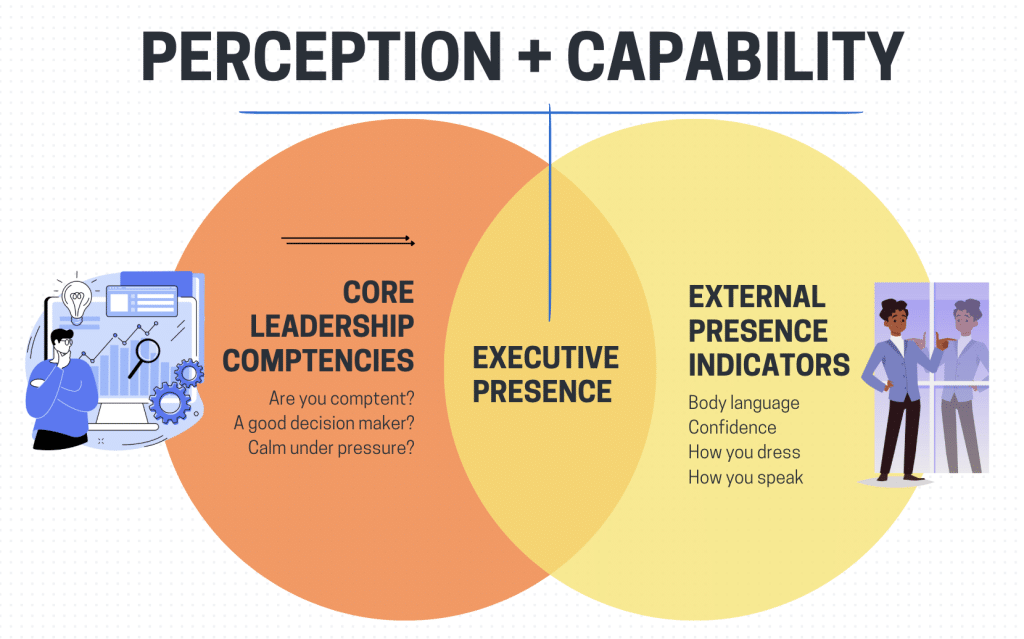
Perception = External Presence. How do you speak? How do you carry yourself? How do you move in a room? These are aspects you can change relatively quickly. For example, how you dress, your posture, or the way you speak. These signals are often what people notice first.
Capacity = Core Qualities. Are you competent? Can you make good decisions? Can you remain calm and composed under pressure? Can you thrive under stress? In other words, do you have the qualities that make someone a great leader?
Let’s explore start off by exploring how you can build executive presence quickly by mastering the External Presence Indicators:
How To Build Executive Presence: 12 Tactics
So, how exactly do you build your presence?
Let’s dive into specific tactics, and explore some examples of people with strong executive and leadership presence:
1. Speak deliberately: Own the room
One of the best ways to develop executive presence is to slow down and speak deliberately.
You’ve probably noticed this in other great speakers too.
When you think of someone with executive presence, who comes to mind? And when you look at how they speak: Are they calm, composed, and deliberate in their rate of speech? Or do they rush through their words?
I’ll bet that they are most likely very deliberate and composed in how they communicate.
Why?
When you slow down, you signal your confidence and composure
You’re signaling to the room: “I’m confidence. I’m calm. I’m in control.” These are key aspects of executive and leadership presence.
Now, I recognize that this is hard to do, and takes practice.
In fact, I remember my own early days of speaking. I rushed through my words, trying to get everything out as quickly as possible. Silence seemed scary!
But, it’s something I’ve gotten much at better at through by being more conscious of.

Want to see this in action?
Watch how Ramit helps this woman slow down.
Notice how she comes across as more composed and confident when she isn’t rushing through what she’s saying:
If you struggle with this, consider working with a coach. I can help
2. Embrace the full range of your voice
In the last tip, you learned about slowing down.
But, this doesn’t mean that you should always stay at this very slow and deliberate range.
Executive presence is about having range.
You need the ability to be very calm, very composed and slow when you speak. But also, to pick up the pace when you need to build up excitement.
A perfect example of someone that does this very well is the CEO of Advanced Micro Devices, Lisa Su. Watch how she is slow and deliberate in her speech, but also shifts gears to build momentum and energy when needed. In other words: she has range.
This is what gives her executive presence.
So, how do you get this right in your own speaking?
Avoid the monotone voice. Vary the energy and pace when you speak.
Slow down when you’re sharing your most important insights. Let the weight of the words settle.
Speed up when you’re telling a story or building excitement. Your energy will pull your audience in.
And don’t forget to pause. After an important or complex point, give the room a moment to catch up. Let that silence give your words space to land.
Master your energy with hand gestures
If you’re like one of my clients who is struggling with this, then a great tip is to pay attention to your hands.
You can modulate your pitch and pace simply by modulating your hand gestures.
Big gestures naturally speed up your speech, while small, deliberate gestures slow it down.
In other words, your hand gestures can help you control your pace and energy.
Related: 7 key storytelling tactics (and how to apply them)
3. Own your space
Have you ever walked into a room and immediately felt the presence of someone who seemed to own the place?
It’s not just their words.
It’s the way they stand, the way they fill the space around them.
Unfortunately, I’ve seen the exact opposite. Most people don’t even realize that their body language is draining their executive presence.

You walk into a meeting and you’ll see people slouched over in their chairs, hunched over their desk. Their posture is practically screaming, “I’m trying to disappear.”
And guess what?
It works.
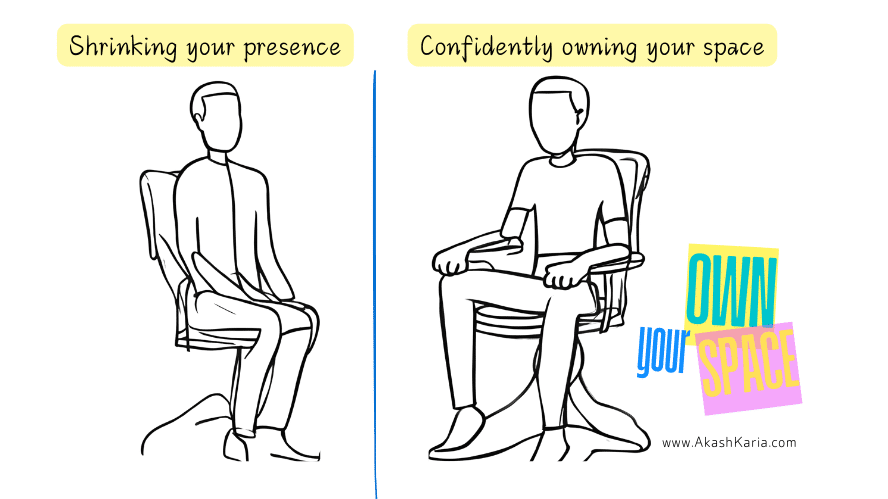
Your executive presence shrinks when you shrink
If you’re trying to shrink yourself down, it’s exactly what happens. Your executive presence shrinks with your body.
Now, imagine standing tall. By that I mean: chest open, back straight. But not in some stiff, robotic way. Picture a thread running from the base of your spine all the way up through the top of your head, gently pulling you taller. It’s subtle, causing you to stand up a little straighter without making you a robot.
I want you to feel the difference the next time you stand or sit.
Don’t just collapse into your seat. Own it. Let your body take up the space you deserve. Don’t tuck your arms in, don’t fold yourself up. Take up the space. Let your arms rest naturally.

Why am I making such a big deal of this?
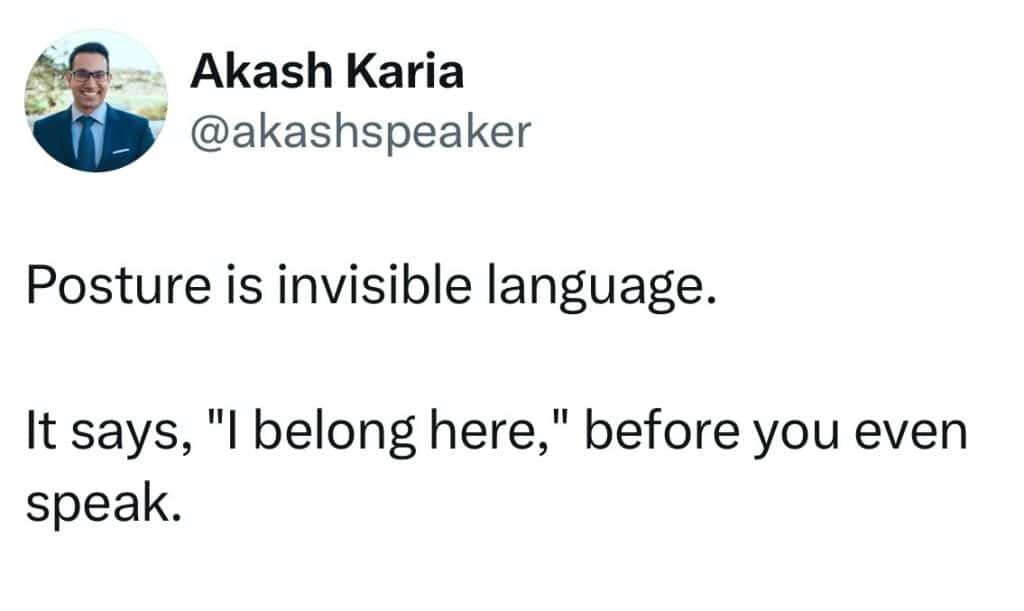
Because posture isn’t just about how you look – it’s how you feel and how people feel about you. When you take up space, you send a signal that says, “I belong here. I’m in charge. I’m someone you want to listen to.”
You can’t lead if you’re trying to hide. You want to feel confident and in control? You want develop executive presence? Start by standing like you already are a leader.
4. Project your voice (without shouting)
Last month, I was running a business storytelling workshop for leaders at a Fortune 100 company.
During the workshop, I asked one of the participants step up on stage to present to the group.
His content was really good and his points were clear.
But, I thought there was a problem.
His voice didn’t fill the room. It wasn’t that he was soft-spoken. It’s just his volume didn’t carry all the way around the room.
So I told him, “Try it again, but this time, raise your volume by 30%.”
He hesitated for a moment. “Akash, I thought I was already loud enough!”
Still, he gave it a shot. And the difference was immediate.
The audience leaned in. They were visibly more engaged. Later, they gave him feedback and told him that he “sounded more confident”, “more engaging” and more “leader-like.”
In other words, he had developed a bit more executive presence just by speaking a little bit louder.

Here’s why I tell you this:
If you want to improve executive presence, you need to project your voice.
Follow the Back-Wall Rule for vocal projection
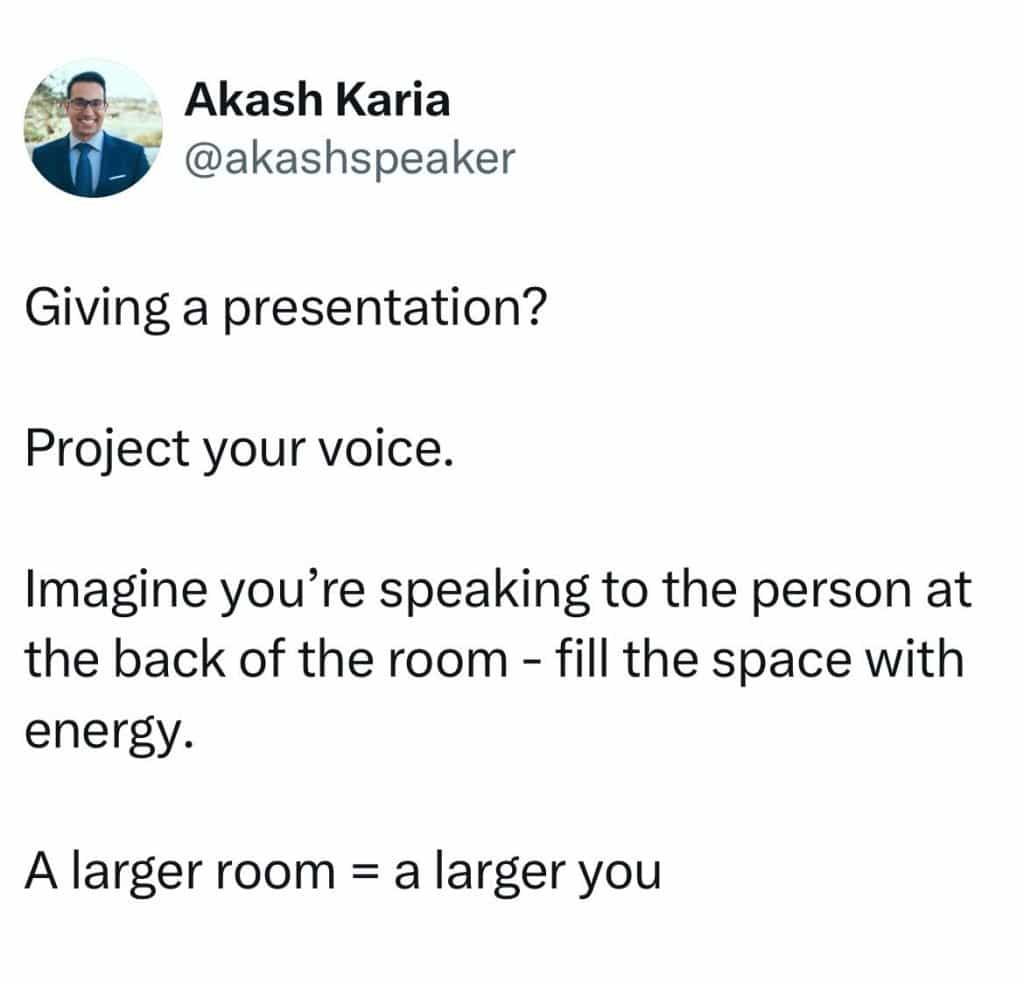
This is where the “Back-Wall Rule” comes in.
Whenever you speak, imagine you’re talking to someone standing at the very back of the room. Your voice should reach them with ease, not by shouting, but by projecting with a bit more breath and energy. Think of your words filling the space, bouncing off that back wall, and making their way back to you.
When it comes to volume, make sure you fill up the room that you’re in. A larger room = louder you.
5. Use eye contact to strengthen your presence
Eye contact is one of those things that sounds so basic, it’s easy to overlook. But if you’re aiming to develop executive presence, it’s one of your most powerful tools.
I once heard my speaker friend, Fredrik Haren, call it “eye connection” instead of “eye contact.” That stuck with me.
Why? Because it’s not just about looking at someone. You want to create that sense of connection.
Hold eye contact for just a moment longer than you’re used to
A great example of this is Bill Clinton.
People who met him often said the same thing.
They said that when he spoke to them, they felt like they were the only person in the room. Why? Because he was totally locked in with them. He was completely present in the moment, giving them his full attention. And it started with his eyes.
So how do you do this in your own interactions?
Next time you’re in a conversation, whether it’s at a meeting or over coffee, try holding someone’s gaze just a second longer than you’re used to.
Your eye contact doesn’t need to be forceful. It shouldn’t be creepy. But you want to practice holding eye contact just a moment longer than you’re normally used to.
6. Master the art of storytelling
One of the most underrated tools for executive influence is storytelling.
Most leaders will tell you that storytelling is important.
They’ll say you should tell a story about your vision or that you should tell a story with data.
But when you ask them, “What do you mean by a story?” they often stumble. They can’t really explain. Or they tell you about data visualization and logical reasoning, but can’t exactly tell you what it means to “tell a story”.
Data and logical reasoning and very important.
But a good story is so much more.
Leaders who know how to tell stories effortlessly attract people to their ideas. Why? Because humans are hardwired for stories. Stories are how we make sense of the world. They’re how we learn.
Data and logic might inform people, but a story moves them. It connects at an emotional level.
And when you can learn how to connect on an emotional level, you’ll automatically improve your executive presence.
Master the 7 storytelling tactics here
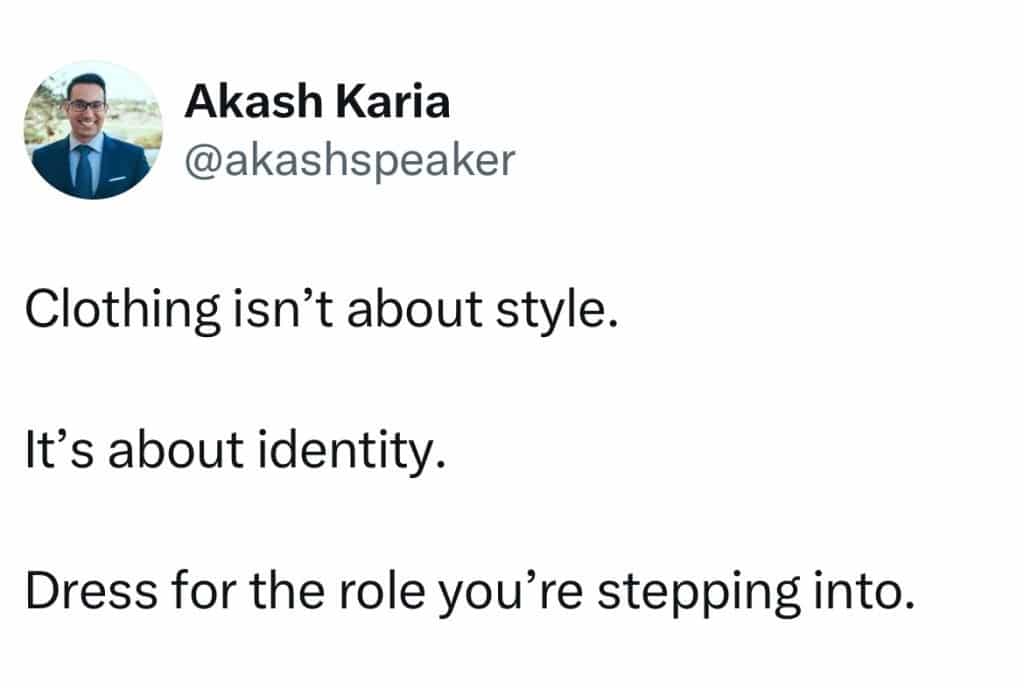
7. Dress for the role you want to play
Let’s talk about executive presence and appearance:
How you dress impacts how others perceive you.
Yes, I know Mark Zuckerberg wears t-shirts on stage, and Steve Jobs had his iconic black turtleneck.
But let’s be real: you’re not Zuckerberg or Jobs.

These are individuals whose accomplishments speak louder than any outfit they wear.
For the rest of us?
We need to be more strategic with our clothing choices.
Here’s what works:
– Invest in quality pieces that fit well.
– Keep everything clean, well-pressed, and presentable.
– Dress one notch above your audience.
Don’t let your clothing undermine your executive presence
You’re not trying to be fashionable or trendy.
You’re aiming for smart, professional attire that signals authority.
Now, does dressing well make you a better leader? No, not necessarily.
But dressing poorly can absolutely undermine your executive presence.
If you want to develop executive presence, start by dressing in a way that doesn’t take away from it.
—
Now that we’ve explored those quick tips on external presence – how you speak, stand, dress – let’s move onto the core qualities of executive presence.
These are those deeper qualities by which people judge your capacity for executive leadership.
Here’s an interesting thought experiment:
Can someone who is shy, introverted, and quiet still have executive presence?
My answer might surprise you.
Yes.
It’s hard, but it is certainly possible.
Why?
Let me give you an example.
Is Elon Musk the best speaker?
No – he’s sometimes quite awkward. He stumbles over his words very often (as you can see in the video below).
But does he have executive presence? Absolutely. Without a doubt.
Why? Because we value and trust his decision-making skills and competence.
Competence creates the kind of confidence that can’t be faked.
Competence gives you the kind of confidence that can’t be faked. It shows in how you carry yourself. It’s steady. It’s grounded. It’s real.
So ask yourself, are you doing the work to upgrade your competence? Are you investing in your skills? Are you staying curious about your industry? Are you diving into new tools and tactics that could give you an edge?
Competence is what allows you to connect the dots no one else can see. It builds your credibility. It shapes how others see you and, more importantly, it gives you a real sense of self-confidence that translates into executive presence.

9. Work with an executive coach
Confidence comes from competence, but what if you’re already good at what you do and still don’t feel confident?
That’s something I see all the time.
People who are sharp, capable, and talented, yet their self-doubt holds them back.
It’s frustrating, right?
You know you’re qualified, but for some reason, it doesn’t translate into how you show up. And here’s the thing. Executive presence isn’t just about what you know. It’s about how others feel when you’re in the room. That’s perception. And if your confidence isn’t strong, people can sense it.
This is where working with an executive coach can make all the difference.
An executive coach can help you rewire your mindset
Most of the time, you can’t see what’s actually holding you back.
Maybe it’s your tone of voice not matching your message. Maybe you avoid eye contact or fidget in meetings without even realizing it. These are things your colleagues notice, but they won’t tell you.
That’s where working with an executive coach can come in very useful.
A coach will help you spot the things you’re blind to and help you correct them. They’ll give you the kind of feedback your colleagues are too afraid too.
But here’s the real value…
Working with an executive coach will rewire your mindset. A good coach will pinpoint the thought patterns holding you back. They’ll help you align your self-perception with the competence you already have.
This is what builds executive presence. Because when you stop doubting yourself all the time, your confidence can naturally shine through.
10. Master composure when the stakes are high
If I had to describe executive presence in one word, it would be composure. It’s about staying calm as a leader when everything around you is chaotic, keeping your head while others are losing theirs.

But how do you develop composure when everything seems to be working against you?
It starts with recognizing your emotions before they take over. When stress, frustration, or doubt start to rise, take a step back.
Instead of reacting, simply acknowledge what’s going on inside. I’m feeling anxious or I’m getting defensive. Just recognizing that feeling in the moment is powerful.
A key skill for executive presence is staying calm and poised under pressure
Next, practice the art of not reacting immediately.
Just because you’re feeling angry or frustrated doesn’t mean you have to lash out.
It’s like a muscle. The more you practice not reacting right away, the more control you have. Mindfulness is a skill, and one that can be trained.
Look at this example with Steve Jobs:
The question is one that personally attacks him.
But, instead of rushing into a response, what does he do?
He pauses.
He takes his time.
He doesn’t react right away.
He sits with the question (and whatever emotion that stirred up in him) before the choosing a response.
As a result, his answer is calm, measured, and composed.
To me, this is a perfect example of choosing how you want to react, instead of letting the emotion dictating the response.
Is this easy?
Absolutely not!
Is it a skill worth developing?
100%.
11. Lead with purpose: Articulate your why
If you haven’t seen Simon Sinek’s TED Talk Start With Why, watch it:
What I’ve noticed over the years is this: leaders who are clear on their vision and can articulate their why naturally radiate executive presence.
People are drawn to leaders who are anchored in something bigger than their daily tasks or goals.
We all want to feel like our work and lives have meaning beyond just checking off boxes or balancing the books. This is what gives you authority as a leader and draws people in. When you tap into your sense of purpose, it helps you build executive presence naturally.
But, here’s where you might be thinking:
“Akash, I don’t have a vision! I have don’t have a sense of purpose.”

That’s okay. The mistake many people make is thinking their purpose or vision has to be something huge. Usually something about “changing the world”.
…But your purpose does not need to be grand
But not every leader’s purpose has to be so grand and noble.
Purpose can be simple. It’s about what you care about.
Maybe it’s the mastery of a domain. Perhaps you’re passionate about a subject and want to get really good at it. Think Warren Buffet in the early days. His purpose was simply to be a great investor. He just cared about being very good at technical analysis, and finding the right companies to invest in.
Or maybe your purpose is about community. For example, you just want to create a team culture where people love showing up to work.
Or maybe your purpose is rooted in a value you care deeply about. For example, you just really care about service excellence and are committed to high standards.
All of that is purpose.
Take a moment and think about your own why.
What drives you? What do you care about? What do you stand for?
12. Don’t hog the spotlight
You’re reading this post because you want to build executive presence.
But here’s the thing…
Don’t make the mistake of thinking executive presence means you have to claim the spotlight all the time or constantly prove yourself.
You don’t.
And honestly, you shouldn’t.
Executive presence isn’t just about how well you speak, but also how well you listen
Confident speech is important, but there’s another key element to executive presence: a willingness to truly listen.
Why?
Because true listening builds your competence. It allows you to learn from the collective intelligence of your team. It makes you smarter! It allows you to make better decisions. It earns you the respect of your team.
“But Akash, how do I become a better listener?”
Start with a willingness to listen.
Resist the urge to speak just to prove how smart you are.
Ask questions that open the conversation and show people you value other people’s input.
Don’t think about what you’re going to say next or interrupt the flow. Effective listening is a core leadership skill. Just be willing to listen and contribute when you have something useful to say.
Case Study: How Nick Developed Executive Presence
Many years ago, I worked with a client named Nick.
Nick came to me wanting to build executive presence. He was a lawyer at a prestigious firm and gave technical presentations regularly. But in high-stakes meetings, he felt something was missing.
He was not by any means terrible, but he just didn’t have that “it factor”.
We spent a few weeks working together. We focused on how he everything from what he said, to his body language, vocal presence, and more.
A few weeks later, I received an email from his boss. She wrote:
“You’ve worked magic of Nick! He’s so much more confident and composed.”
In other words: Nick had now developed that “X factor”. He had developed executive presence.
In this post, you’ve learned some of the same tactics I taught Nick on how develop executive presence.
They’re also some of the same skills I teach in my communication workshops.
The great news is that, as you practice these skills, you’ll inevitably improve.
Executive presence is a learnable skill, and one that anyone can get better at.
Get in touch here if you’d like to discuss a keynote, workshop or coaching.
F.A.Qs
OK, time for some quick F.A.Q’s. before we wrap up with a summary on how you can build executive presence.
Here are some of the most common questions I get:
What is executive presence?
Executive presence is what makes people trust in your leadership.
It’s a key leadership quality that signals to people, “I have what it takes to lead.”
Executive presence shows up in the way you communicate, in the way you project poise under pressure, and the way you inspire others to action.
This is why executive presence matters.
Because executive presence = leadership presence.
Executive presence is what makes people believe in your ability to lead.
And when they believe you can lead, they’re more likely to follow you.
Why is it important to develop executive presence?
Executive presence matters because, when you have it:
People pay attention to what you say. They trust your judgment. And they feel confident following your lead.
In other word, building executive presence can improve your leadership effectiveness.
When people pay attention to you, trust you, and follow you, you can create more value at work, open doors to new opportunities, and become a more valuable part of your organization.
Does executive presence only matter for senior leaders?
No. Executive presence is important for everyone who wants to lead, regardless of your current position. If you aspire to lead more effectively, then you’ll benefit from having a stronger executive presence.
What’s the quickest way to build my executive presence?
Executive presence is made up of several key elements. It includes everything from how well you communicate, to your decision making skills, and your composure under stress. All of these matter, but to start with just one. Choose the one aspect of executive presence and work at it for the next 90 days. Then, once you’ve improved that, move onto the next aspect.
Executive Presence: Summary
Most people think that build executive presence is about having charisma or confidence. But, there’s much more to it than that.
As you’ve learned, dexecutive presence is about two things:
- Perception: How people perceive you
- Capacity: What you bring to the table.
Perception comes from how confidently you speak, how you dress, etc. Capacity is your ability to back that up with real competence: your ability to make good decisions, listen well, and stay calm under stress.
If you want to build executive presence, don’t try to master everything at once. Start small. Work on speaking more clearly or handling high-stakes situations without showing stress.
And if you’re serious about leveling up, get an executive presence coach.
The right guidance can take you from being overlooked to being someone people trust to lead.
If you’d like to discuss how I can help you, click here to get to get in touch

If you’re like one of my clients who is struggling with this, then a great tip is to pay attention to your hands.
You can modulate your pitch and pace simply by modulating your hand gestures.
Big gestures naturally speed up your speech, while small, deliberate gestures slow it down.
In other words, your hand gestures can help you control your pace and energy.
Related: 7 key storytelling tactics (and how to apply them)
3. Own your space
Have you ever walked into a room and immediately felt the presence of someone who seemed to own the place?
It’s not just their words.
It’s the way they stand, the way they fill the space around them.
Unfortunately, I’ve seen the exact opposite. Most people don’t even realize that their body language is draining their executive presence.
You walk into a meeting and you’ll see people slouched over in their chairs, hunched over their desk. Their posture is practically screaming, “I’m trying to disappear.”
And guess what?
It works.
Your executive presence shrinks when you shrink
If you’re trying to shrink yourself down, it’s exactly what happens. Your executive presence shrinks with your body.
Now, imagine standing tall. By that I mean: chest open, back straight. But not in some stiff, robotic way. Picture a thread running from the base of your spine all the way up through the top of your head, gently pulling you taller. It’s subtle, causing you to stand up a little straighter without making you a robot.
I want you to feel the difference the next time you stand or sit.
Don’t just collapse into your seat. Own it. Let your body take up the space you deserve. Don’t tuck your arms in, don’t fold yourself up. Take up the space. Let your arms rest naturally.
Why am I making such a big deal of this?
Because posture isn’t just about how you look – it’s how you feel and how people feel about you. When you take up space, you send a signal that says, “I belong here. I’m in charge. I’m someone you want to listen to.”
You can’t lead if you’re trying to hide. You want to feel confident and in control? You want develop executive presence? Start by standing like you already are a leader.
4. Project your voice (without shouting)
Last month, I was running a business storytelling workshop for leaders at a Fortune 100 company.
During the workshop, I asked one of the participants step up on stage to present to the group.
His content was really good and his points were clear.
But, I thought there was a problem.
His voice didn’t fill the room. It wasn’t that he was soft-spoken. It’s just his volume didn’t carry all the way around the room.
So I told him, “Try it again, but this time, raise your volume by 30%.”
He hesitated for a moment. “Akash, I thought I was already loud enough!”
Still, he gave it a shot. And the difference was immediate.
The audience leaned in. They were visibly more engaged. Later, they gave him feedback and told him that he “sounded more confident”, “more engaging” and more “leader-like.”
In other words, he had developed a bit more executive presence just by speaking a little bit louder.
Here’s why I tell you this:
If you want to improve executive presence, you need to project your voice.
Follow the Back-Wall Rule for vocal projection
This is where the “Back-Wall Rule” comes in.
Whenever you speak, imagine you’re talking to someone standing at the very back of the room. Your voice should reach them with ease, not by shouting, but by projecting with a bit more breath and energy. Think of your words filling the space, bouncing off that back wall, and making their way back to you.
When it comes to volume, make sure you fill up the room that you’re in. A larger room = louder you.
5. Use eye contact to strengthen your presence
Eye contact is one of those things that sounds so basic, it’s easy to overlook. But if you’re aiming to develop executive presence, it’s one of your most powerful tools.
I once heard my speaker friend, Fredrik Haren, call it “eye connection” instead of “eye contact.” That stuck with me.
Why? Because it’s not just about looking at someone. You want to create that sense of connection.
Hold eye contact for just a moment longer than you’re used to
A great example of this is Bill Clinton.
People who met him often said the same thing.
They said that when he spoke to them, they felt like they were the only person in the room. Why? Because he was totally locked in with them. He was completely present in the moment, giving them his full attention. And it started with his eyes.
So how do you do this in your own interactions?
Next time you’re in a conversation, whether it’s at a meeting or over coffee, try holding someone’s gaze just a second longer than you’re used to.
Your eye contact doesn’t need to be forceful. It shouldn’t be creepy. But you want to practice holding eye contact just a moment longer than you’re normally used to.
6. Master the art of storytelling
One of the most underrated tools for executive influence is storytelling.
Most leaders will tell you that storytelling is important.
They’ll say you should tell a story about your vision or that you should tell a story with data.
But when you ask them, “What do you mean by a story?” they often stumble. They can’t really explain. Or they tell you about data visualization and logical reasoning, but can’t exactly tell you what it means to “tell a story”.
Data and logical reasoning and very important.
But a good story is so much more.
Leaders who know how to tell stories effortlessly attract people to their ideas. Why? Because humans are hardwired for stories. Stories are how we make sense of the world. They’re how we learn.
Data and logic might inform people, but a story moves them. It connects at an emotional level.
And when you can learn how to connect on an emotional level, you’ll automatically improve your executive presence.
Master the 7 storytelling tactics here
7. Dress for the role you want to play
Let’s talk about executive presence and appearance:
How you dress impacts how others perceive you.
Yes, I know Mark Zuckerberg wears t-shirts on stage, and Steve Jobs had his iconic black turtleneck.
But let’s be real: you’re not Zuckerberg or Jobs.
These are individuals whose accomplishments speak louder than any outfit they wear.
For the rest of us?
We need to be more strategic with our clothing choices.
Here’s what works:
– Invest in quality pieces that fit well.
– Keep everything clean, well-pressed, and presentable.
– Dress one notch above your audience.
Don’t let your clothing undermine your executive presence
You’re not trying to be fashionable or trendy.
You’re aiming for smart, professional attire that signals authority.
Now, does dressing well make you a better leader? No, not necessarily.
But dressing poorly can absolutely undermine your executive presence.
If you want to develop executive presence, start by dressing in a way that doesn’t take away from it.
—
Now that we’ve explored those quick tips on external presence – how you speak, stand, dress – let’s move onto the core qualities of executive presence.
These are those deeper qualities by which people judge your capacity for executive leadership.
Here’s an interesting thought experiment:
Can someone who is shy, introverted, and quiet still have executive presence?
My answer might surprise you.
Yes.
It’s hard, but it is certainly possible.
Why?
Let me give you an example.
Is Elon Musk the best speaker?
No – he’s sometimes quite awkward. He stumbles over his words very often (as you can see in the video below).
But does he have executive presence? Absolutely. Without a doubt.
Why? Because we value and trust his decision-making skills and competence.
Competence creates the kind of confidence that can’t be faked.
Competence gives you the kind of confidence that can’t be faked. It shows in how you carry yourself. It’s steady. It’s grounded. It’s real.
So ask yourself, are you doing the work to upgrade your competence? Are you investing in your skills? Are you staying curious about your industry? Are you diving into new tools and tactics that could give you an edge?
Competence is what allows you to connect the dots no one else can see. It builds your credibility. It shapes how others see you and, more importantly, it gives you a real sense of self-confidence that translates into executive presence.
9. Work with an executive coach
Confidence comes from competence, but what if you’re already good at what you do and still don’t feel confident?
That’s something I see all the time.
People who are sharp, capable, and talented, yet their self-doubt holds them back.
It’s frustrating, right?
You know you’re qualified, but for some reason, it doesn’t translate into how you show up. And here’s the thing. Executive presence isn’t just about what you know. It’s about how others feel when you’re in the room. That’s perception. And if your confidence isn’t strong, people can sense it.
This is where working with an executive coach can make all the difference.
An executive coach can help you rewire your mindset
Most of the time, you can’t see what’s actually holding you back.
Maybe it’s your tone of voice not matching your message. Maybe you avoid eye contact or fidget in meetings without even realizing it. These are things your colleagues notice, but they won’t tell you.
That’s where working with an executive coach can come in very useful.
A coach will help you spot the things you’re blind to and help you correct them. They’ll give you the kind of feedback your colleagues are too afraid too.
But here’s the real value…
Working with an executive coach will rewire your mindset. A good coach will pinpoint the thought patterns holding you back. They’ll help you align your self-perception with the competence you already have.
This is what builds executive presence. Because when you stop doubting yourself all the time, your confidence can naturally shine through.
10. Master composure when the stakes are high
If I had to describe executive presence in one word, it would be composure. It’s about staying calm as a leader when everything around you is chaotic, keeping your head while others are losing theirs.
But how do you develop composure when everything seems to be working against you?
It starts with recognizing your emotions before they take over. When stress, frustration, or doubt start to rise, take a step back.
Instead of reacting, simply acknowledge what’s going on inside. I’m feeling anxious or I’m getting defensive. Just recognizing that feeling in the moment is powerful.
A key skill for executive presence is staying calm and poised under pressure
Next, practice the art of not reacting immediately.
Just because you’re feeling angry or frustrated doesn’t mean you have to lash out.
It’s like a muscle. The more you practice not reacting right away, the more control you have. Mindfulness is a skill, and one that can be trained.
Look at this example with Steve Jobs:
The question is one that personally attacks him.
But, instead of rushing into a response, what does he do?
He pauses.
He takes his time.
He doesn’t react right away.
He sits with the question (and whatever emotion that stirred up in him) before the choosing a response.
As a result, his answer is calm, measured, and composed.
To me, this is a perfect example of choosing how you want to react, instead of letting the emotion dictating the response.
Is this easy?
Absolutely not!
Is it a skill worth developing?
100%.
11. Lead with purpose: Articulate your why
If you haven’t seen Simon Sinek’s TED Talk Start With Why, watch it:
What I’ve noticed over the years is this: leaders who are clear on their vision and can articulate their why naturally radiate executive presence.
People are drawn to leaders who are anchored in something bigger than their daily tasks or goals.
We all want to feel like our work and lives have meaning beyond just checking off boxes or balancing the books. This is what gives you authority as a leader and draws people in. When you tap into your sense of purpose, it helps you build executive presence naturally.
But, here’s where you might be thinking:
“Akash, I don’t have a vision! I have don’t have a sense of purpose.”
That’s okay. The mistake many people make is thinking their purpose or vision has to be something huge. Usually something about “changing the world”.
…But your purpose does not need to be grand
But not every leader’s purpose has to be so grand and noble.
Purpose can be simple. It’s about what you care about.
Maybe it’s the mastery of a domain. Perhaps you’re passionate about a subject and want to get really good at it. Think Warren Buffet in the early days. His purpose was simply to be a great investor. He just cared about being very good at technical analysis, and finding the right companies to invest in.
Or maybe your purpose is about community. For example, you just want to create a team culture where people love showing up to work.
Or maybe your purpose is rooted in a value you care deeply about. For example, you just really care about service excellence and are committed to high standards.
All of that is purpose.
Take a moment and think about your own why.
What drives you? What do you care about? What do you stand for?
12. Don’t hog the spotlight
You’re reading this post because you want to build executive presence.
But here’s the thing…
Don’t make the mistake of thinking executive presence means you have to claim the spotlight all the time or constantly prove yourself.
You don’t.
And honestly, you shouldn’t.
Executive presence isn’t just about how well you speak, but also how well you listen
Confident speech is important, but there’s another key element to executive presence: a willingness to truly listen.
Why?
Because true listening builds your competence. It allows you to learn from the collective intelligence of your team. It makes you smarter! It allows you to make better decisions. It earns you the respect of your team.
“But Akash, how do I become a better listener?”
Start with a willingness to listen.
Resist the urge to speak just to prove how smart you are.
Ask questions that open the conversation and show people you value other people’s input.
Don’t think about what you’re going to say next or interrupt the flow. Effective listening is a core leadership skill. Just be willing to listen and contribute when you have something useful to say.
Case Study: How Nick Developed Executive Presence
Many years ago, I worked with a client named Nick.
Nick came to me wanting to build executive presence. He was a lawyer at a prestigious firm and gave technical presentations regularly. But in high-stakes meetings, he felt something was missing.
He was not by any means terrible, but he just didn’t have that “it factor”.
We spent a few weeks working together. We focused on how he everything from what he said, to his body language, vocal presence, and more.
A few weeks later, I received an email from his boss. She wrote:
“You’ve worked magic of Nick! He’s so much more confident and composed.”
In other words: Nick had now developed that “X factor”. He had developed executive presence.
In this post, you’ve learned some of the same tactics I taught Nick on how develop executive presence.
They’re also some of the same skills I teach in my communication workshops.
The great news is that, as you practice these skills, you’ll inevitably improve.
Executive presence is a learnable skill, and one that anyone can get better at.
Get in touch here if you’d like to discuss a keynote, workshop or coaching.
F.A.Qs
OK, time for some quick F.A.Q’s. before we wrap up with a summary on how you can build executive presence.
Here are some of the most common questions I get:
What is executive presence?
Executive presence is what makes people trust in your leadership.
It’s a key leadership quality that signals to people, “I have what it takes to lead.”
Executive presence shows up in the way you communicate, in the way you project poise under pressure, and the way you inspire others to action.
This is why executive presence matters.
Because executive presence = leadership presence.
Executive presence is what makes people believe in your ability to lead.
And when they believe you can lead, they’re more likely to follow you.
Why is it important to develop executive presence?
Executive presence matters because, when you have it:
People pay attention to what you say. They trust your judgment. And they feel confident following your lead.
In other word, building executive presence can improve your leadership effectiveness.
When people pay attention to you, trust you, and follow you, you can create more value at work, open doors to new opportunities, and become a more valuable part of your organization.
Does executive presence only matter for senior leaders?
No. Executive presence is important for everyone who wants to lead, regardless of your current position. If you aspire to lead more effectively, then you’ll benefit from having a stronger executive presence.
What’s the quickest way to build my executive presence?
Executive presence is made up of several key elements. It includes everything from how well you communicate, to your decision making skills, and your composure under stress. All of these matter, but to start with just one. Choose the one aspect of executive presence and work at it for the next 90 days. Then, once you’ve improved that, move onto the next aspect.
Executive Presence: Summary
Most people think that build executive presence is about having charisma or confidence. But, there’s much more to it than that.
As you’ve learned, dexecutive presence is about two things:
- Perception: How people perceive you
- Capacity: What you bring to the table.
Perception comes from how confidently you speak, how you dress, etc. Capacity is your ability to back that up with real competence: your ability to make good decisions, listen well, and stay calm under stress.
If you want to build executive presence, don’t try to master everything at once. Start small. Work on speaking more clearly or handling high-stakes situations without showing stress.
And if you’re serious about leveling up, get an executive presence coach.
The right guidance can take you from being overlooked to being someone people trust to lead.
If you’d like to discuss how I can help you, click here to get to get in touch
This is where the “Back-Wall Rule” comes in.
Whenever you speak, imagine you’re talking to someone standing at the very back of the room. Your voice should reach them with ease, not by shouting, but by projecting with a bit more breath and energy. Think of your words filling the space, bouncing off that back wall, and making their way back to you.
When it comes to volume, make sure you fill up the room that you’re in. A larger room = louder you.
5. Use eye contact to strengthen your presence
Eye contact is one of those things that sounds so basic, it’s easy to overlook. But if you’re aiming to develop executive presence, it’s one of your most powerful tools.
I once heard my speaker friend, Fredrik Haren, call it “eye connection” instead of “eye contact.” That stuck with me.
Why? Because it’s not just about looking at someone. You want to create that sense of connection.
Hold eye contact for just a moment longer than you’re used to
A great example of this is Bill Clinton.
People who met him often said the same thing.
They said that when he spoke to them, they felt like they were the only person in the room. Why? Because he was totally locked in with them. He was completely present in the moment, giving them his full attention. And it started with his eyes.
So how do you do this in your own interactions?
Next time you’re in a conversation, whether it’s at a meeting or over coffee, try holding someone’s gaze just a second longer than you’re used to.
Your eye contact doesn’t need to be forceful. It shouldn’t be creepy. But you want to practice holding eye contact just a moment longer than you’re normally used to.
6. Master the art of storytelling
One of the most underrated tools for executive influence is storytelling.
Most leaders will tell you that storytelling is important.
They’ll say you should tell a story about your vision or that you should tell a story with data.
But when you ask them, “What do you mean by a story?” they often stumble. They can’t really explain. Or they tell you about data visualization and logical reasoning, but can’t exactly tell you what it means to “tell a story”.
Data and logical reasoning and very important.
But a good story is so much more.
Leaders who know how to tell stories effortlessly attract people to their ideas. Why? Because humans are hardwired for stories. Stories are how we make sense of the world. They’re how we learn.
Data and logic might inform people, but a story moves them. It connects at an emotional level.
And when you can learn how to connect on an emotional level, you’ll automatically improve your executive presence.
Master the 7 storytelling tactics here
7. Dress for the role you want to play
Let’s talk about executive presence and appearance:
How you dress impacts how others perceive you.
Yes, I know Mark Zuckerberg wears t-shirts on stage, and Steve Jobs had his iconic black turtleneck.
But let’s be real: you’re not Zuckerberg or Jobs.
These are individuals whose accomplishments speak louder than any outfit they wear.
For the rest of us?
We need to be more strategic with our clothing choices.
Here’s what works:
– Invest in quality pieces that fit well.
– Keep everything clean, well-pressed, and presentable.
– Dress one notch above your audience.
Don’t let your clothing undermine your executive presence
You’re not trying to be fashionable or trendy.
You’re aiming for smart, professional attire that signals authority.
Now, does dressing well make you a better leader? No, not necessarily.
But dressing poorly can absolutely undermine your executive presence.
If you want to develop executive presence, start by dressing in a way that doesn’t take away from it.
—
Now that we’ve explored those quick tips on external presence – how you speak, stand, dress – let’s move onto the core qualities of executive presence.
These are those deeper qualities by which people judge your capacity for executive leadership.
Here’s an interesting thought experiment:
Can someone who is shy, introverted, and quiet still have executive presence?
My answer might surprise you.
Yes.
It’s hard, but it is certainly possible.
Why?
Let me give you an example.
Is Elon Musk the best speaker?
No – he’s sometimes quite awkward. He stumbles over his words very often (as you can see in the video below).
But does he have executive presence? Absolutely. Without a doubt.
Why? Because we value and trust his decision-making skills and competence.
Competence creates the kind of confidence that can’t be faked.
Competence gives you the kind of confidence that can’t be faked. It shows in how you carry yourself. It’s steady. It’s grounded. It’s real.
So ask yourself, are you doing the work to upgrade your competence? Are you investing in your skills? Are you staying curious about your industry? Are you diving into new tools and tactics that could give you an edge?
Competence is what allows you to connect the dots no one else can see. It builds your credibility. It shapes how others see you and, more importantly, it gives you a real sense of self-confidence that translates into executive presence.
9. Work with an executive coach
Confidence comes from competence, but what if you’re already good at what you do and still don’t feel confident?
That’s something I see all the time.
People who are sharp, capable, and talented, yet their self-doubt holds them back.
It’s frustrating, right?
You know you’re qualified, but for some reason, it doesn’t translate into how you show up. And here’s the thing. Executive presence isn’t just about what you know. It’s about how others feel when you’re in the room. That’s perception. And if your confidence isn’t strong, people can sense it.
This is where working with an executive coach can make all the difference.
An executive coach can help you rewire your mindset
Most of the time, you can’t see what’s actually holding you back.
Maybe it’s your tone of voice not matching your message. Maybe you avoid eye contact or fidget in meetings without even realizing it. These are things your colleagues notice, but they won’t tell you.
That’s where working with an executive coach can come in very useful.
A coach will help you spot the things you’re blind to and help you correct them. They’ll give you the kind of feedback your colleagues are too afraid too.
But here’s the real value…
Working with an executive coach will rewire your mindset. A good coach will pinpoint the thought patterns holding you back. They’ll help you align your self-perception with the competence you already have.
This is what builds executive presence. Because when you stop doubting yourself all the time, your confidence can naturally shine through.
10. Master composure when the stakes are high
If I had to describe executive presence in one word, it would be composure. It’s about staying calm as a leader when everything around you is chaotic, keeping your head while others are losing theirs.
But how do you develop composure when everything seems to be working against you?
It starts with recognizing your emotions before they take over. When stress, frustration, or doubt start to rise, take a step back.
Instead of reacting, simply acknowledge what’s going on inside. I’m feeling anxious or I’m getting defensive. Just recognizing that feeling in the moment is powerful.
A key skill for executive presence is staying calm and poised under pressure
Next, practice the art of not reacting immediately.
Just because you’re feeling angry or frustrated doesn’t mean you have to lash out.
It’s like a muscle. The more you practice not reacting right away, the more control you have. Mindfulness is a skill, and one that can be trained.
Look at this example with Steve Jobs:
The question is one that personally attacks him.
But, instead of rushing into a response, what does he do?
He pauses.
He takes his time.
He doesn’t react right away.
He sits with the question (and whatever emotion that stirred up in him) before the choosing a response.
As a result, his answer is calm, measured, and composed.
To me, this is a perfect example of choosing how you want to react, instead of letting the emotion dictating the response.
Is this easy?
Absolutely not!
Is it a skill worth developing?
100%.
11. Lead with purpose: Articulate your why
If you haven’t seen Simon Sinek’s TED Talk Start With Why, watch it:
What I’ve noticed over the years is this: leaders who are clear on their vision and can articulate their why naturally radiate executive presence.
People are drawn to leaders who are anchored in something bigger than their daily tasks or goals.
We all want to feel like our work and lives have meaning beyond just checking off boxes or balancing the books. This is what gives you authority as a leader and draws people in. When you tap into your sense of purpose, it helps you build executive presence naturally.
But, here’s where you might be thinking:
“Akash, I don’t have a vision! I have don’t have a sense of purpose.”
That’s okay. The mistake many people make is thinking their purpose or vision has to be something huge. Usually something about “changing the world”.
…But your purpose does not need to be grand
But not every leader’s purpose has to be so grand and noble.
Purpose can be simple. It’s about what you care about.
Maybe it’s the mastery of a domain. Perhaps you’re passionate about a subject and want to get really good at it. Think Warren Buffet in the early days. His purpose was simply to be a great investor. He just cared about being very good at technical analysis, and finding the right companies to invest in.
Or maybe your purpose is about community. For example, you just want to create a team culture where people love showing up to work.
Or maybe your purpose is rooted in a value you care deeply about. For example, you just really care about service excellence and are committed to high standards.
All of that is purpose.
Take a moment and think about your own why.
What drives you? What do you care about? What do you stand for?
12. Don’t hog the spotlight
You’re reading this post because you want to build executive presence.
But here’s the thing…
Don’t make the mistake of thinking executive presence means you have to claim the spotlight all the time or constantly prove yourself.
You don’t.
And honestly, you shouldn’t.
Executive presence isn’t just about how well you speak, but also how well you listen
Confident speech is important, but there’s another key element to executive presence: a willingness to truly listen.
Why?
Because true listening builds your competence. It allows you to learn from the collective intelligence of your team. It makes you smarter! It allows you to make better decisions. It earns you the respect of your team.
“But Akash, how do I become a better listener?”
Start with a willingness to listen.
Resist the urge to speak just to prove how smart you are.
Ask questions that open the conversation and show people you value other people’s input.
Don’t think about what you’re going to say next or interrupt the flow. Effective listening is a core leadership skill. Just be willing to listen and contribute when you have something useful to say.
Case Study: How Nick Developed Executive Presence
Many years ago, I worked with a client named Nick.
Nick came to me wanting to build executive presence. He was a lawyer at a prestigious firm and gave technical presentations regularly. But in high-stakes meetings, he felt something was missing.
He was not by any means terrible, but he just didn’t have that “it factor”.
We spent a few weeks working together. We focused on how he everything from what he said, to his body language, vocal presence, and more.
A few weeks later, I received an email from his boss. She wrote:
“You’ve worked magic of Nick! He’s so much more confident and composed.”
In other words: Nick had now developed that “X factor”. He had developed executive presence.
In this post, you’ve learned some of the same tactics I taught Nick on how develop executive presence.
They’re also some of the same skills I teach in my communication workshops.
The great news is that, as you practice these skills, you’ll inevitably improve.
Executive presence is a learnable skill, and one that anyone can get better at.
Get in touch here if you’d like to discuss a keynote, workshop or coaching.
F.A.Qs
OK, time for some quick F.A.Q’s. before we wrap up with a summary on how you can build executive presence.
Here are some of the most common questions I get:
What is executive presence?
Executive presence is what makes people trust in your leadership.
It’s a key leadership quality that signals to people, “I have what it takes to lead.”
Executive presence shows up in the way you communicate, in the way you project poise under pressure, and the way you inspire others to action.
This is why executive presence matters.
Because executive presence = leadership presence.
Executive presence is what makes people believe in your ability to lead.
And when they believe you can lead, they’re more likely to follow you.
Why is it important to develop executive presence?
Executive presence matters because, when you have it:
People pay attention to what you say. They trust your judgment. And they feel confident following your lead.
In other word, building executive presence can improve your leadership effectiveness.
When people pay attention to you, trust you, and follow you, you can create more value at work, open doors to new opportunities, and become a more valuable part of your organization.
Does executive presence only matter for senior leaders?
No. Executive presence is important for everyone who wants to lead, regardless of your current position. If you aspire to lead more effectively, then you’ll benefit from having a stronger executive presence.
What’s the quickest way to build my executive presence?
Executive presence is made up of several key elements. It includes everything from how well you communicate, to your decision making skills, and your composure under stress. All of these matter, but to start with just one. Choose the one aspect of executive presence and work at it for the next 90 days. Then, once you’ve improved that, move onto the next aspect.
Executive Presence: Summary
Most people think that build executive presence is about having charisma or confidence. But, there’s much more to it than that.
As you’ve learned, dexecutive presence is about two things:
- Perception: How people perceive you
- Capacity: What you bring to the table.
Perception comes from how confidently you speak, how you dress, etc. Capacity is your ability to back that up with real competence: your ability to make good decisions, listen well, and stay calm under stress.
If you want to build executive presence, don’t try to master everything at once. Start small. Work on speaking more clearly or handling high-stakes situations without showing stress.
And if you’re serious about leveling up, get an executive presence coach.
The right guidance can take you from being overlooked to being someone people trust to lead.
If you’d like to discuss how I can help you, click here to get to get in touch
– Keep everything clean, well-pressed, and presentable.
– Dress one notch above your audience.
You’re not trying to be fashionable or trendy.
You’re aiming for smart, professional attire that signals authority.
Now, does dressing well make you a better leader? No, not necessarily.
But dressing poorly can absolutely undermine your executive presence.
If you want to develop executive presence, start by dressing in a way that doesn’t take away from it.
—
Now that we’ve explored those quick tips on external presence – how you speak, stand, dress – let’s move onto the core qualities of executive presence.
These are those deeper qualities by which people judge your capacity for executive leadership.
Here’s an interesting thought experiment:
Can someone who is shy, introverted, and quiet still have executive presence?
My answer might surprise you.
Yes.
It’s hard, but it is certainly possible.
Why?
Let me give you an example.
Is Elon Musk the best speaker?
No – he’s sometimes quite awkward. He stumbles over his words very often (as you can see in the video below).
But does he have executive presence? Absolutely. Without a doubt.
Why? Because we value and trust his decision-making skills and competence.
Competence creates the kind of confidence that can’t be faked.
Competence gives you the kind of confidence that can’t be faked. It shows in how you carry yourself. It’s steady. It’s grounded. It’s real.
So ask yourself, are you doing the work to upgrade your competence? Are you investing in your skills? Are you staying curious about your industry? Are you diving into new tools and tactics that could give you an edge?
Competence is what allows you to connect the dots no one else can see. It builds your credibility. It shapes how others see you and, more importantly, it gives you a real sense of self-confidence that translates into executive presence.
9. Work with an executive coach
Confidence comes from competence, but what if you’re already good at what you do and still don’t feel confident?
That’s something I see all the time.
People who are sharp, capable, and talented, yet their self-doubt holds them back.
It’s frustrating, right?
You know you’re qualified, but for some reason, it doesn’t translate into how you show up. And here’s the thing. Executive presence isn’t just about what you know. It’s about how others feel when you’re in the room. That’s perception. And if your confidence isn’t strong, people can sense it.
This is where working with an executive coach can make all the difference.
An executive coach can help you rewire your mindset
Most of the time, you can’t see what’s actually holding you back.
Maybe it’s your tone of voice not matching your message. Maybe you avoid eye contact or fidget in meetings without even realizing it. These are things your colleagues notice, but they won’t tell you.
That’s where working with an executive coach can come in very useful.
A coach will help you spot the things you’re blind to and help you correct them. They’ll give you the kind of feedback your colleagues are too afraid too.
But here’s the real value…
Working with an executive coach will rewire your mindset. A good coach will pinpoint the thought patterns holding you back. They’ll help you align your self-perception with the competence you already have.
This is what builds executive presence. Because when you stop doubting yourself all the time, your confidence can naturally shine through.
10. Master composure when the stakes are high
If I had to describe executive presence in one word, it would be composure. It’s about staying calm as a leader when everything around you is chaotic, keeping your head while others are losing theirs.
But how do you develop composure when everything seems to be working against you?
It starts with recognizing your emotions before they take over. When stress, frustration, or doubt start to rise, take a step back.
Instead of reacting, simply acknowledge what’s going on inside. I’m feeling anxious or I’m getting defensive. Just recognizing that feeling in the moment is powerful.
A key skill for executive presence is staying calm and poised under pressure
Next, practice the art of not reacting immediately.
Just because you’re feeling angry or frustrated doesn’t mean you have to lash out.
It’s like a muscle. The more you practice not reacting right away, the more control you have. Mindfulness is a skill, and one that can be trained.
Look at this example with Steve Jobs:
The question is one that personally attacks him.
But, instead of rushing into a response, what does he do?
He pauses.
He takes his time.
He doesn’t react right away.
He sits with the question (and whatever emotion that stirred up in him) before the choosing a response.
As a result, his answer is calm, measured, and composed.
To me, this is a perfect example of choosing how you want to react, instead of letting the emotion dictating the response.
Is this easy?
Absolutely not!
Is it a skill worth developing?
100%.
11. Lead with purpose: Articulate your why
If you haven’t seen Simon Sinek’s TED Talk Start With Why, watch it:
What I’ve noticed over the years is this: leaders who are clear on their vision and can articulate their why naturally radiate executive presence.
People are drawn to leaders who are anchored in something bigger than their daily tasks or goals.
We all want to feel like our work and lives have meaning beyond just checking off boxes or balancing the books. This is what gives you authority as a leader and draws people in. When you tap into your sense of purpose, it helps you build executive presence naturally.
But, here’s where you might be thinking:
“Akash, I don’t have a vision! I have don’t have a sense of purpose.”
That’s okay. The mistake many people make is thinking their purpose or vision has to be something huge. Usually something about “changing the world”.
…But your purpose does not need to be grand
But not every leader’s purpose has to be so grand and noble.
Purpose can be simple. It’s about what you care about.
Maybe it’s the mastery of a domain. Perhaps you’re passionate about a subject and want to get really good at it. Think Warren Buffet in the early days. His purpose was simply to be a great investor. He just cared about being very good at technical analysis, and finding the right companies to invest in.
Or maybe your purpose is about community. For example, you just want to create a team culture where people love showing up to work.
Or maybe your purpose is rooted in a value you care deeply about. For example, you just really care about service excellence and are committed to high standards.
All of that is purpose.
Take a moment and think about your own why.
What drives you? What do you care about? What do you stand for?
12. Don’t hog the spotlight
You’re reading this post because you want to build executive presence.
But here’s the thing…
Don’t make the mistake of thinking executive presence means you have to claim the spotlight all the time or constantly prove yourself.
You don’t.
And honestly, you shouldn’t.
Executive presence isn’t just about how well you speak, but also how well you listen
Confident speech is important, but there’s another key element to executive presence: a willingness to truly listen.
Why?
Because true listening builds your competence. It allows you to learn from the collective intelligence of your team. It makes you smarter! It allows you to make better decisions. It earns you the respect of your team.
“But Akash, how do I become a better listener?”
Start with a willingness to listen.
Resist the urge to speak just to prove how smart you are.
Ask questions that open the conversation and show people you value other people’s input.
Don’t think about what you’re going to say next or interrupt the flow. Effective listening is a core leadership skill. Just be willing to listen and contribute when you have something useful to say.
Case Study: How Nick Developed Executive Presence
Many years ago, I worked with a client named Nick.
Nick came to me wanting to build executive presence. He was a lawyer at a prestigious firm and gave technical presentations regularly. But in high-stakes meetings, he felt something was missing.
He was not by any means terrible, but he just didn’t have that “it factor”.
We spent a few weeks working together. We focused on how he everything from what he said, to his body language, vocal presence, and more.
A few weeks later, I received an email from his boss. She wrote:
“You’ve worked magic of Nick! He’s so much more confident and composed.”
In other words: Nick had now developed that “X factor”. He had developed executive presence.
In this post, you’ve learned some of the same tactics I taught Nick on how develop executive presence.
They’re also some of the same skills I teach in my communication workshops.
The great news is that, as you practice these skills, you’ll inevitably improve.
Executive presence is a learnable skill, and one that anyone can get better at.
Get in touch here if you’d like to discuss a keynote, workshop or coaching.
F.A.Qs
OK, time for some quick F.A.Q’s. before we wrap up with a summary on how you can build executive presence.
Here are some of the most common questions I get:
What is executive presence?
Executive presence is what makes people trust in your leadership.
It’s a key leadership quality that signals to people, “I have what it takes to lead.”
Executive presence shows up in the way you communicate, in the way you project poise under pressure, and the way you inspire others to action.
This is why executive presence matters.
Because executive presence = leadership presence.
Executive presence is what makes people believe in your ability to lead.
And when they believe you can lead, they’re more likely to follow you.
Why is it important to develop executive presence?
Executive presence matters because, when you have it:
People pay attention to what you say. They trust your judgment. And they feel confident following your lead.
In other word, building executive presence can improve your leadership effectiveness.
When people pay attention to you, trust you, and follow you, you can create more value at work, open doors to new opportunities, and become a more valuable part of your organization.
Does executive presence only matter for senior leaders?
No. Executive presence is important for everyone who wants to lead, regardless of your current position. If you aspire to lead more effectively, then you’ll benefit from having a stronger executive presence.
What’s the quickest way to build my executive presence?
Executive presence is made up of several key elements. It includes everything from how well you communicate, to your decision making skills, and your composure under stress. All of these matter, but to start with just one. Choose the one aspect of executive presence and work at it for the next 90 days. Then, once you’ve improved that, move onto the next aspect.
Executive Presence: Summary
Most people think that build executive presence is about having charisma or confidence. But, there’s much more to it than that.
As you’ve learned, dexecutive presence is about two things:
- Perception: How people perceive you
- Capacity: What you bring to the table.
Perception comes from how confidently you speak, how you dress, etc. Capacity is your ability to back that up with real competence: your ability to make good decisions, listen well, and stay calm under stress.
If you want to build executive presence, don’t try to master everything at once. Start small. Work on speaking more clearly or handling high-stakes situations without showing stress.
And if you’re serious about leveling up, get an executive presence coach.
The right guidance can take you from being overlooked to being someone people trust to lead.
If you’d like to discuss how I can help you, click here to get to get in touch

Most of the time, you can’t see what’s actually holding you back.
Maybe it’s your tone of voice not matching your message. Maybe you avoid eye contact or fidget in meetings without even realizing it. These are things your colleagues notice, but they won’t tell you.
That’s where working with an executive coach can come in very useful.
A coach will help you spot the things you’re blind to and help you correct them. They’ll give you the kind of feedback your colleagues are too afraid too.
But here’s the real value…
Working with an executive coach will rewire your mindset. A good coach will pinpoint the thought patterns holding you back. They’ll help you align your self-perception with the competence you already have.
This is what builds executive presence. Because when you stop doubting yourself all the time, your confidence can naturally shine through.
10. Master composure when the stakes are high
If I had to describe executive presence in one word, it would be composure. It’s about staying calm as a leader when everything around you is chaotic, keeping your head while others are losing theirs.

But how do you develop composure when everything seems to be working against you?
It starts with recognizing your emotions before they take over. When stress, frustration, or doubt start to rise, take a step back.
Instead of reacting, simply acknowledge what’s going on inside. I’m feeling anxious or I’m getting defensive. Just recognizing that feeling in the moment is powerful.
A key skill for executive presence is staying calm and poised under pressure
Next, practice the art of not reacting immediately.
Just because you’re feeling angry or frustrated doesn’t mean you have to lash out.
It’s like a muscle. The more you practice not reacting right away, the more control you have. Mindfulness is a skill, and one that can be trained.
Look at this example with Steve Jobs:
The question is one that personally attacks him.
But, instead of rushing into a response, what does he do?
He pauses.
He takes his time.
He doesn’t react right away.
He sits with the question (and whatever emotion that stirred up in him) before the choosing a response.
As a result, his answer is calm, measured, and composed.
To me, this is a perfect example of choosing how you want to react, instead of letting the emotion dictating the response.
Is this easy?
Absolutely not!
Is it a skill worth developing?
100%.
11. Lead with purpose: Articulate your why
If you haven’t seen Simon Sinek’s TED Talk Start With Why, watch it:
What I’ve noticed over the years is this: leaders who are clear on their vision and can articulate their why naturally radiate executive presence.
People are drawn to leaders who are anchored in something bigger than their daily tasks or goals.
We all want to feel like our work and lives have meaning beyond just checking off boxes or balancing the books. This is what gives you authority as a leader and draws people in. When you tap into your sense of purpose, it helps you build executive presence naturally.
But, here’s where you might be thinking:
“Akash, I don’t have a vision! I have don’t have a sense of purpose.”
That’s okay. The mistake many people make is thinking their purpose or vision has to be something huge. Usually something about “changing the world”.
…But your purpose does not need to be grand
But not every leader’s purpose has to be so grand and noble.
Purpose can be simple. It’s about what you care about.
Maybe it’s the mastery of a domain. Perhaps you’re passionate about a subject and want to get really good at it. Think Warren Buffet in the early days. His purpose was simply to be a great investor. He just cared about being very good at technical analysis, and finding the right companies to invest in.
Or maybe your purpose is about community. For example, you just want to create a team culture where people love showing up to work.
Or maybe your purpose is rooted in a value you care deeply about. For example, you just really care about service excellence and are committed to high standards.
All of that is purpose.
Take a moment and think about your own why.
What drives you? What do you care about? What do you stand for?
12. Don’t hog the spotlight
You’re reading this post because you want to build executive presence.
But here’s the thing…
Don’t make the mistake of thinking executive presence means you have to claim the spotlight all the time or constantly prove yourself.
You don’t.
And honestly, you shouldn’t.
Executive presence isn’t just about how well you speak, but also how well you listen
Confident speech is important, but there’s another key element to executive presence: a willingness to truly listen.
Why?
Because true listening builds your competence. It allows you to learn from the collective intelligence of your team. It makes you smarter! It allows you to make better decisions. It earns you the respect of your team.
“But Akash, how do I become a better listener?”
Start with a willingness to listen.
Resist the urge to speak just to prove how smart you are.
Ask questions that open the conversation and show people you value other people’s input.
Don’t think about what you’re going to say next or interrupt the flow. Effective listening is a core leadership skill. Just be willing to listen and contribute when you have something useful to say.
Case Study: How Nick Developed Executive Presence
Many years ago, I worked with a client named Nick.
Nick came to me wanting to build executive presence. He was a lawyer at a prestigious firm and gave technical presentations regularly. But in high-stakes meetings, he felt something was missing.
He was not by any means terrible, but he just didn’t have that “it factor”.
We spent a few weeks working together. We focused on how he everything from what he said, to his body language, vocal presence, and more.
A few weeks later, I received an email from his boss. She wrote:
“You’ve worked magic of Nick! He’s so much more confident and composed.”
In other words: Nick had now developed that “X factor”. He had developed executive presence.
In this post, you’ve learned some of the same tactics I taught Nick on how develop executive presence.
They’re also some of the same skills I teach in my communication workshops.
The great news is that, as you practice these skills, you’ll inevitably improve.
Executive presence is a learnable skill, and one that anyone can get better at.
Get in touch here if you’d like to discuss a keynote, workshop or coaching.
F.A.Qs
OK, time for some quick F.A.Q’s. before we wrap up with a summary on how you can build executive presence.
Here are some of the most common questions I get:
What is executive presence?
Executive presence is what makes people trust in your leadership.
It’s a key leadership quality that signals to people, “I have what it takes to lead.”
Executive presence shows up in the way you communicate, in the way you project poise under pressure, and the way you inspire others to action.
This is why executive presence matters.
Because executive presence = leadership presence.
Executive presence is what makes people believe in your ability to lead.
And when they believe you can lead, they’re more likely to follow you.
Why is it important to develop executive presence?
Executive presence matters because, when you have it:
People pay attention to what you say. They trust your judgment. And they feel confident following your lead.
In other word, building executive presence can improve your leadership effectiveness.
When people pay attention to you, trust you, and follow you, you can create more value at work, open doors to new opportunities, and become a more valuable part of your organization.
Does executive presence only matter for senior leaders?
No. Executive presence is important for everyone who wants to lead, regardless of your current position. If you aspire to lead more effectively, then you’ll benefit from having a stronger executive presence.
What’s the quickest way to build my executive presence?
Executive presence is made up of several key elements. It includes everything from how well you communicate, to your decision making skills, and your composure under stress. All of these matter, but to start with just one. Choose the one aspect of executive presence and work at it for the next 90 days. Then, once you’ve improved that, move onto the next aspect.
Executive Presence: Summary
Most people think that build executive presence is about having charisma or confidence. But, there’s much more to it than that.
As you’ve learned, dexecutive presence is about two things:
- Perception: How people perceive you
- Capacity: What you bring to the table.
Perception comes from how confidently you speak, how you dress, etc. Capacity is your ability to back that up with real competence: your ability to make good decisions, listen well, and stay calm under stress.
If you want to build executive presence, don’t try to master everything at once. Start small. Work on speaking more clearly or handling high-stakes situations without showing stress.
And if you’re serious about leveling up, get an executive presence coach.
The right guidance can take you from being overlooked to being someone people trust to lead.
If you’d like to discuss how I can help you, click here to get to get in touch
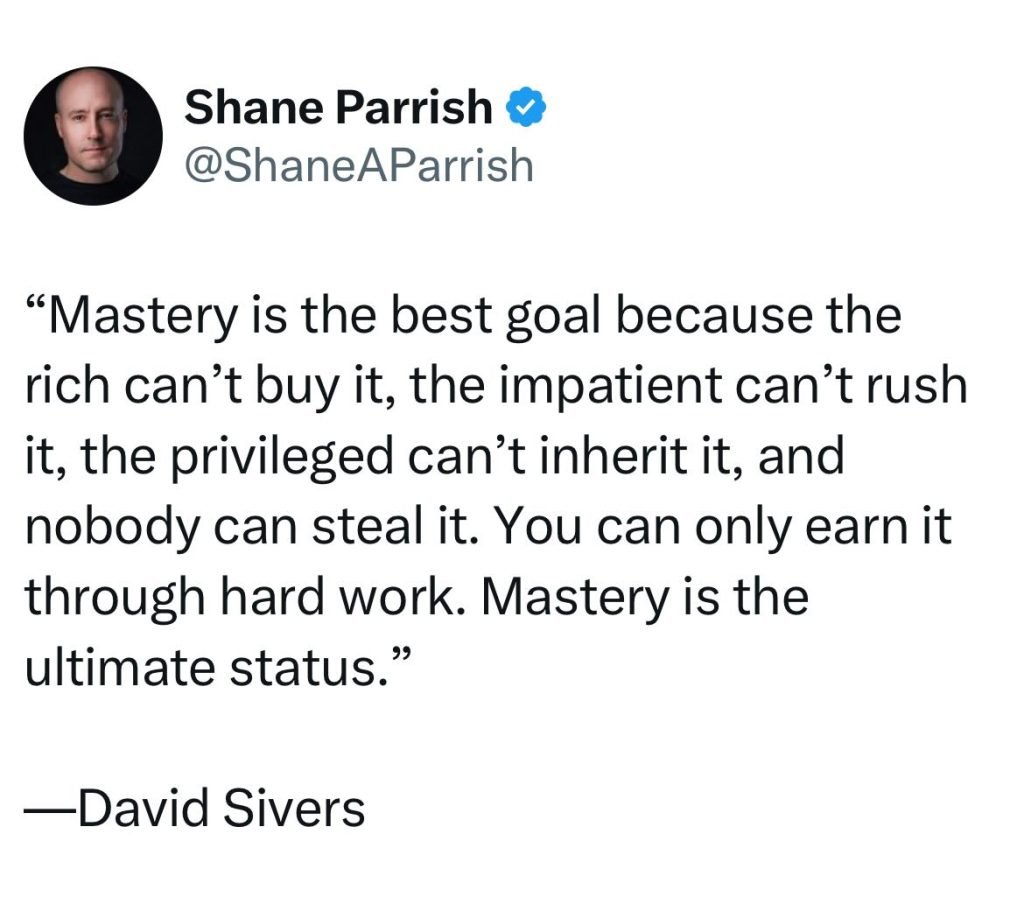
But not every leader’s purpose has to be so grand and noble.
Purpose can be simple. It’s about what you care about.
Maybe it’s the mastery of a domain. Perhaps you’re passionate about a subject and want to get really good at it. Think Warren Buffet in the early days. His purpose was simply to be a great investor. He just cared about being very good at technical analysis, and finding the right companies to invest in.
Or maybe your purpose is about community. For example, you just want to create a team culture where people love showing up to work.
Or maybe your purpose is rooted in a value you care deeply about. For example, you just really care about service excellence and are committed to high standards.
All of that is purpose.
Take a moment and think about your own why.
What drives you? What do you care about? What do you stand for?
12. Don’t hog the spotlight
You’re reading this post because you want to build executive presence.
But here’s the thing…
Don’t make the mistake of thinking executive presence means you have to claim the spotlight all the time or constantly prove yourself.
You don’t.
And honestly, you shouldn’t.
Executive presence isn’t just about how well you speak, but also how well you listen
Confident speech is important, but there’s another key element to executive presence: a willingness to truly listen.
Why?
Because true listening builds your competence. It allows you to learn from the collective intelligence of your team. It makes you smarter! It allows you to make better decisions. It earns you the respect of your team.
“But Akash, how do I become a better listener?”
Start with a willingness to listen.
Resist the urge to speak just to prove how smart you are.
Ask questions that open the conversation and show people you value other people’s input.
Don’t think about what you’re going to say next or interrupt the flow. Effective listening is a core leadership skill. Just be willing to listen and contribute when you have something useful to say.
Case Study: How Nick Developed Executive Presence
Many years ago, I worked with a client named Nick.
Nick came to me wanting to build executive presence. He was a lawyer at a prestigious firm and gave technical presentations regularly. But in high-stakes meetings, he felt something was missing.
He was not by any means terrible, but he just didn’t have that “it factor”.
We spent a few weeks working together. We focused on how he everything from what he said, to his body language, vocal presence, and more.
A few weeks later, I received an email from his boss. She wrote:
“You’ve worked magic of Nick! He’s so much more confident and composed.”
In other words: Nick had now developed that “X factor”. He had developed executive presence.
In this post, you’ve learned some of the same tactics I taught Nick on how develop executive presence.
They’re also some of the same skills I teach in my communication workshops.
The great news is that, as you practice these skills, you’ll inevitably improve.
Executive presence is a learnable skill, and one that anyone can get better at.
Get in touch here if you’d like to discuss a keynote, workshop or coaching.
F.A.Qs
OK, time for some quick F.A.Q’s. before we wrap up with a summary on how you can build executive presence.
Here are some of the most common questions I get:
What is executive presence?
Executive presence is what makes people trust in your leadership.
It’s a key leadership quality that signals to people, “I have what it takes to lead.”
Executive presence shows up in the way you communicate, in the way you project poise under pressure, and the way you inspire others to action.
This is why executive presence matters.
Because executive presence = leadership presence.
Executive presence is what makes people believe in your ability to lead.
And when they believe you can lead, they’re more likely to follow you.
Why is it important to develop executive presence?
Executive presence matters because, when you have it:
People pay attention to what you say. They trust your judgment. And they feel confident following your lead.
In other word, building executive presence can improve your leadership effectiveness.
When people pay attention to you, trust you, and follow you, you can create more value at work, open doors to new opportunities, and become a more valuable part of your organization.
Does executive presence only matter for senior leaders?
No. Executive presence is important for everyone who wants to lead, regardless of your current position. If you aspire to lead more effectively, then you’ll benefit from having a stronger executive presence.
What’s the quickest way to build my executive presence?
Executive presence is made up of several key elements. It includes everything from how well you communicate, to your decision making skills, and your composure under stress. All of these matter, but to start with just one. Choose the one aspect of executive presence and work at it for the next 90 days. Then, once you’ve improved that, move onto the next aspect.
Executive Presence: Summary
Most people think that build executive presence is about having charisma or confidence. But, there’s much more to it than that.
As you’ve learned, dexecutive presence is about two things:
- Perception: How people perceive you
- Capacity: What you bring to the table.
Perception comes from how confidently you speak, how you dress, etc. Capacity is your ability to back that up with real competence: your ability to make good decisions, listen well, and stay calm under stress.
If you want to build executive presence, don’t try to master everything at once. Start small. Work on speaking more clearly or handling high-stakes situations without showing stress.
And if you’re serious about leveling up, get an executive presence coach.
The right guidance can take you from being overlooked to being someone people trust to lead.
If you’d like to discuss how I can help you, click here to get to get in touch
Ask questions that open the conversation and show people you value other people’s input.
Don’t think about what you’re going to say next or interrupt the flow. Effective listening is a core leadership skill. Just be willing to listen and contribute when you have something useful to say.
Case Study: How Nick Developed Executive Presence
Many years ago, I worked with a client named Nick.
Nick came to me wanting to build executive presence. He was a lawyer at a prestigious firm and gave technical presentations regularly. But in high-stakes meetings, he felt something was missing.
He was not by any means terrible, but he just didn’t have that “it factor”.
We spent a few weeks working together. We focused on how he everything from what he said, to his body language, vocal presence, and more.
A few weeks later, I received an email from his boss. She wrote:
“You’ve worked magic of Nick! He’s so much more confident and composed.”
In other words: Nick had now developed that “X factor”. He had developed executive presence.
In this post, you’ve learned some of the same tactics I taught Nick on how develop executive presence.
They’re also some of the same skills I teach in my communication workshops.
The great news is that, as you practice these skills, you’ll inevitably improve.
Executive presence is a learnable skill, and one that anyone can get better at.
Get in touch here if you’d like to discuss a keynote, workshop or coaching.
F.A.Qs
OK, time for some quick F.A.Q’s. before we wrap up with a summary on how you can build executive presence.
Here are some of the most common questions I get:
What is executive presence?
Executive presence is what makes people trust in your leadership.
It’s a key leadership quality that signals to people, “I have what it takes to lead.”
Executive presence shows up in the way you communicate, in the way you project poise under pressure, and the way you inspire others to action.
This is why executive presence matters.
Because executive presence = leadership presence.
Executive presence is what makes people believe in your ability to lead.
And when they believe you can lead, they’re more likely to follow you.
Why is it important to develop executive presence?
Executive presence matters because, when you have it:
People pay attention to what you say. They trust your judgment. And they feel confident following your lead.
In other word, building executive presence can improve your leadership effectiveness.
When people pay attention to you, trust you, and follow you, you can create more value at work, open doors to new opportunities, and become a more valuable part of your organization.
Does executive presence only matter for senior leaders?
No. Executive presence is important for everyone who wants to lead, regardless of your current position. If you aspire to lead more effectively, then you’ll benefit from having a stronger executive presence.
What’s the quickest way to build my executive presence?
Executive presence is made up of several key elements. It includes everything from how well you communicate, to your decision making skills, and your composure under stress. All of these matter, but to start with just one. Choose the one aspect of executive presence and work at it for the next 90 days. Then, once you’ve improved that, move onto the next aspect.
Executive Presence: Summary
Most people think that build executive presence is about having charisma or confidence. But, there’s much more to it than that.
As you’ve learned, dexecutive presence is about two things:
- Perception: How people perceive you
- Capacity: What you bring to the table.
Perception comes from how confidently you speak, how you dress, etc. Capacity is your ability to back that up with real competence: your ability to make good decisions, listen well, and stay calm under stress.
If you want to build executive presence, don’t try to master everything at once. Start small. Work on speaking more clearly or handling high-stakes situations without showing stress.
And if you’re serious about leveling up, get an executive presence coach.
The right guidance can take you from being overlooked to being someone people trust to lead.
If you’d like to discuss how I can help you, click here to get to get in touch

