

If you want to learn how to think on your feet, you’re in the right place.
In this guide, I’ll show you the exact 4-step framework I’ve used to train leaders at Gucci, Sony, FedEx, and TikTok to think on their feet and speak clearly under pressure.
It’s called OREO (yes, like the cookie).
And it works in seconds – even when someone puts you on the spot with zero time to prepare.
Speaking on the spot isn’t a knowledge problem. It’s a pressure problem.
The stress spikes, and your brain does one of two things: it blanks, or it rambles.
Here’s the solution:
Why is it so hard to think on your feet?
Because being put on the spot is genuinely high-stress. And under stress, your brain does one of two things.
It blanks. Or it rambles.
After coaching 5,000+ leaders, I can tell you it’s almost never about how much you know. The second all eyes turn to you, the pressure spikes — and your brain stops cooperating.
Some people go blank. They reach for the perfect answer, can’t find it, and freeze.
Most people ramble. They start talking before they’ve organized anything. So they think out loud — circling, backtracking, burying the point under context nobody asked for.
Different reactions. Same root cause: under pressure, you’ve got nothing to hold onto.
The Solution: How to think on your feet and speak clearly – every time
When you’re put on the spot, do four things:
- Lead with one clear point
- Say why you believe it
- Back it with one piece of evidence
- End with one action
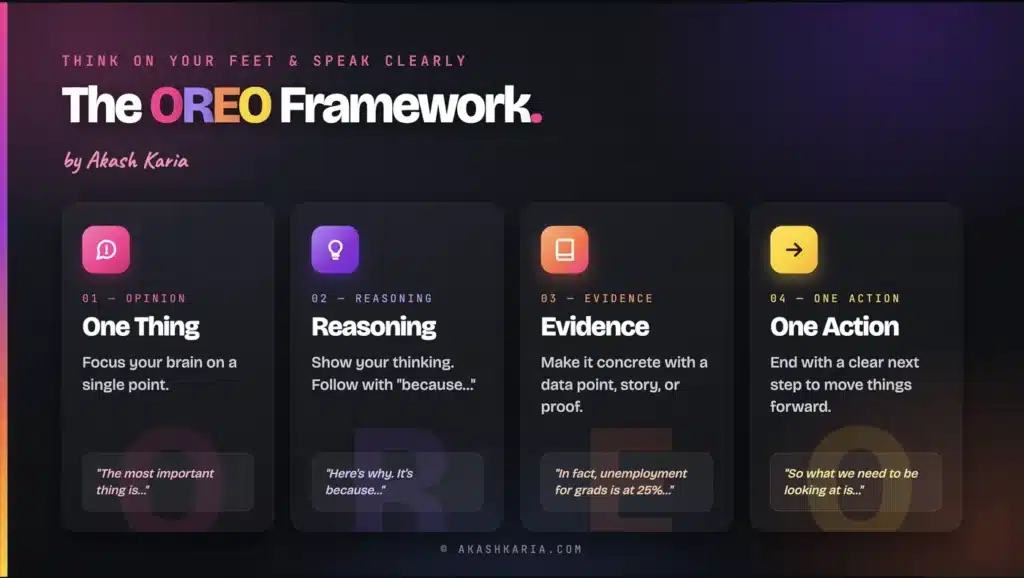
That’s OREO. One Thing, Reasoning, Evidence, One Action.
The two cookies are your point and your action. The cream in the middle is your proof.
The OREO Framework for Clearer Thinking and Speaking
OREO is a four-step framework for thinking on your feet: One Thing, Reasoning, Evidence, One Action.
You may have seen OREO before.
As a writing framework, it stands for Opinion, Reason, Example, Opinion. You state your position, back it up, and restate it at the end.
But I refined the framework to be more suitable for impromptu speaking.
Let’s look at the new OREO framework. Here’s how each step works:
O: One Thing
What’s the one thing you want to say? You ramble because your brain is trying to say everything at once. Forcing it to pick one thing helps you focus and generate ideas.
R: Reasoning
Why do you believe it? Follow your point with a clear “because.”
E: Evidence
What’s your proof? Provide a data point, a story or an example.
(If you reach for a story, give it a simple story structure)
O: One Action
What do you want them to do next? End with a clear next step for what you want your audience to think, feel or do differently.
Here’s how to use master impromptu speaking with the OREO framework (an example)
Let’s say someone asks you:
“What do you think about AI disrupting entry-level jobs?”
Here’s the answer without OREO:
“Yeah… I think AI is going to be a big thing, I mean it already is, and I think entry-level roles will probably change. Some might go away, some might evolve, and there’s this whole thing with companies automating tasks now, and I think it’ll affect different industries in different ways. So yeah, there’s just so much to think about with AI.”
This person clearly knows their stuff.
But they’re rambling without structure. It’s one of the more common presentation mistakes that undermine your message.
Now here’s the same answer structured with my OREO framework:
-
One Thing: “Yes, I believe AI will eliminate a significant number of entry-level jobs within five years.”
-
Reasoning: “Here’s why. It’s because most entry-level work is rules-based and repetitive. And that’s exactly what AI is now good at.”
-
Evidence: “In fact, IBM recently paused hiring for around 7,800 back-office roles it expects AI to handle. Those are exactly the kind of jobs graduates used to get their foot in the door with. And I’m seeing it up close… in my own company, two junior analyst roles have already been replaced by AI tools.”
-
One Action: “So we’ve got to teach grads what AI can’t… how to think critically, and be creative. Because the easy entry-level jobs they used to learn from just aren’t there anymore.”
Notice how this response is far more interesting. Because it’s got a scaffolding on which the thoughts can be built.
How to think on your feet in job interviews, Q&A and meetings
The same four steps work in front of one person or a hundred.
Here’s how OREO plays out in the moments my clients ask about most.
In a job interview (“What would you do in your first 90 days?”)
Lead with your single biggest priority. Say why it matters most. Back it with something you’ve done before. Then name the first concrete step you’d take.
In a board or exec Q&A (“Why is this project behind?”)
Name the single biggest cause first. Don’t list all five.
Give the reason, then the number that proves it. Close by telling them exactly what you need them to decide.
This is how you show executive presence.
When you’re challenged in a meeting (“I don’t think that’ll work.”)
Don’t defend everything at once.
Restate your position in one line. Give your strongest reason and one piece of proof. Then propose a small next step — a pilot, a test.
One more scenario worth preparing for: the question that gets personal. When someone asks what you earn or why you left your last job, OREO will not save you – you need a different toolkit. Here is how to respond to nosy questions without making it awkward.
How do you get better at thinking on your feet?
You get better with reps.
But not random ones. You need reps that drill the OREO structure until it runs on its own.
Here are four you can fit into a normal week.
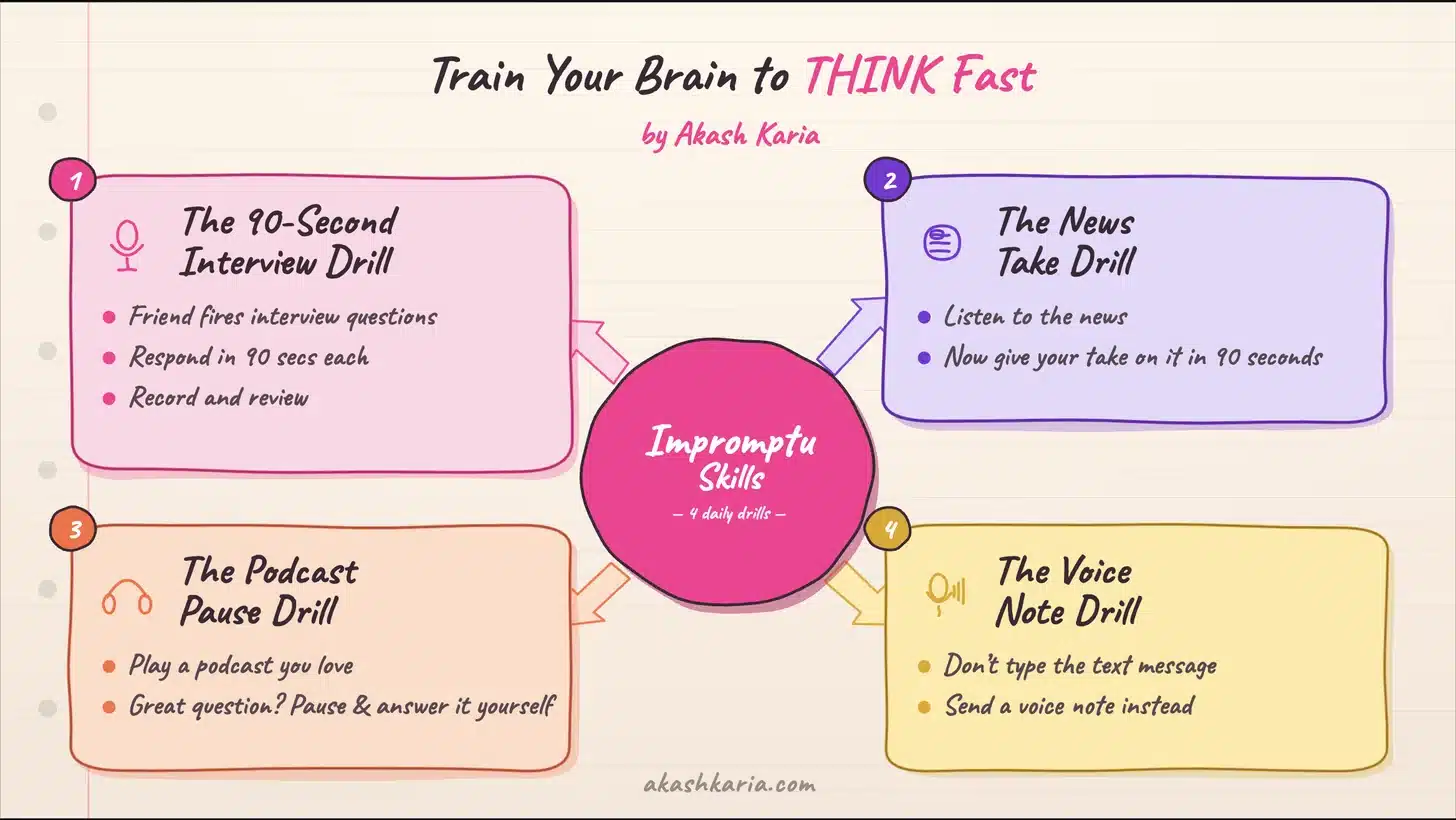
Exercise 1: The 90-second interview drill
Got an interview coming up?
Have a friend fire you a random question.
Then start a 90-second timer.
Your only job:
Answer in OREO — One Thing, Reasoning, Evidence, and (if it fits) One Action (or any other framework that fits the situation).
Do five of these, and the skill of thinking on your feet becomes more automatic.
Bonus: record it on your phone and watch it back.
It’s painful.
But it’s also the fastest fix there is to get better at speaking impromptu.
Exercise 2: The News Take Drill
Pick a news article about your industry.
Give yourself 90 seconds to react to it out loud, in OREO.
What’s your take? Why? What’s your evidence? What’s the one action?
You’re training your brain to form a clear opinion fast, on things that matter in your industry.
Exercise 3: The Podcast Pause Drill
Play your favorite podcast.
Then, when the host asks the guest an interesting question … hit pause.
Now answer the questions yourself, out loud, before you un-pause and hear the guest.
(Just make sure you’re not driving).
This way, you’re rehearsing your ability to think on the spot on real questions – from real experts.
Exercise 4: The Voice Note Drill
One of the best ways to learn to think on your feet is using voice notes.
For example, next time you get a message over WhatsApp or Signal asking for project update or a “what do you think?”, reply with a voice note.
Replay it once before you send. You’ll catch every ramble.
And then do it again.
Do a few of these a day for a couple of weeks.
(This is one of my favorite techniques for getting more reps in to improve my impromptu speaking skills).
Try this the next time you’re put on the spot
Under pressure, your brain has no filter and no structure.
Psychologists call it cognitive overload.
That’s why you either go blank, or ramble.
OREO gives your brain a clear structure upon which to build your thinking.
One Thing. Reasoning. Evidence. One Action.
OREO is one of many possible frameworks, but its a versatile and useful one. So the next time someone puts you on the spot, pause.
Think “One Thing.”
Then add in Reason and Evidence.
And, as a bonus point, include an One Action for the next step.
Now you’ve gone from “I hate impromptu speaking” to being able to think on your feet and answer in a way that’s genuinely useful and interesting.
Frequently Asked Questions
How do I stop rambling when I’m nervous?
Pick one point before you speak, and say it first. Rambling is a structure problem, not a knowledge problem. Lead with a single clear statement and your brain stops scanning for everything at once.
What’s the difference between OREO and PREP?
PREP is Point, Reason, Example, Point. OREO is One Thing, Reasoning, Evidence, One Action. Same opening logic – but OREO swaps the repeated point for a forward-looking action.
Can you actually learn to think on your feet?
Yes. It’s a structure, not a gift. The people who seem naturally quick have just internalized a framework so deeply they don’t notice they’re using one.
Where can I practice impromptu speaking skills?
Low-stakes moments are best for practice. Think team meetings, casual Q&A, even dinner conversations. Toastmasters and improv help too. But the real reps come from applying a framework in everyday talk.
About the author
Akash Karia is a keynote speaker and author. For 15 years he’s helped leaders communicate with clarity and confidence under pressure, working with teams at companies like Gucci, Sony, FedEx, and TikTok. He delivers communication keynotes and workshops across Asia Pacific. Book Akash for a corporate keynote or workshop.

