In this in-depth article, you’ll learn how to craft a personal brand story for sales. Learn how storytelling helps you connect with clients in seconds, build trust, and win more sales.
Key Takeaways:
- The fastest way to build influence is through a personal brand story, not credentials. Neuroscience proves storytelling syncs brains and triggers trust-building chemistry.
-
Clients form a “trust verdict” in the first 7 seconds. If you’re seen as a pushy salesperson, you’ve already lost the sale. A story helps you sell without selling.
-
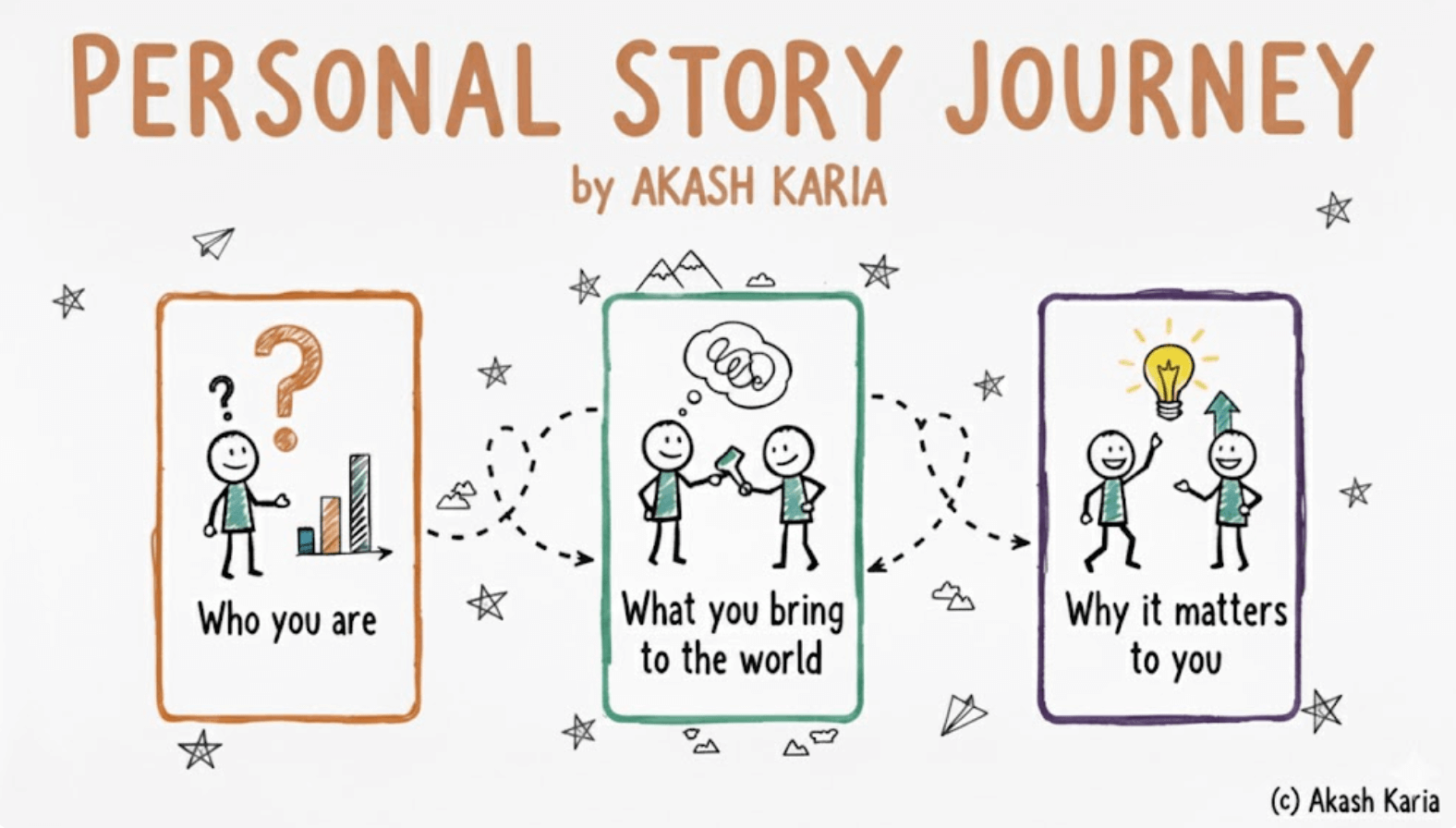
Use The Backstory–Belief–Bridge storytelling framework to craft an effective personal brand story:
-
Backstory: A meaningful experience that shaped your perspective.
-
Belief: The key insight or lesson you learned.
-
Bridge: How your experience helps solve the client’s specific problem.
-
- The best personal brand stories are clear and concise. Forget those 15-step storytelling blueprints – the simple personal brand storytelling blueprint gives you exactly what you need for a real sales situation.
Let’s dive in…
Facing the “Who Are You?” Moment in Sales
I was recently leading workshops for a group of high-performing insurance salespeople who sell to affluent clients.
I asked the room a simple question:
“If you were put on the spot, could you introduce yourself in a way that actually makes the client want to work with you?”
In a room full of top-tier sales professionals, most hands stayed down.
They face the same high-stakes moment every day. Yet, for most of them, they’re unprepared with to answer.
If you are reading this, you likely face it too situation too. Whether you are meeting a prospective client for the first time or interviewing for a new job, you will have to answer the implied question:
“Who are you, and why should I listen to you?”
The Problem with Standard Sales Intros
Unfortunately, most salespeople default to the standard sales script when it comes to their self-intros:
- “I’m the VP of Sales at X company.”
- “We’ve been in business 10 years.”
- “We have the best software in the industry.”
- “We’ve won XYZ award for the last 5 years in a row.”
It’s boring.
It’s dull.
And it wastes your only chance to frame yourself as a trusted expert before the real conversation begins.
Clients Form a “Trust Verdict” in 7 Seconds.
According to psychology research on rapid cognition, the human brain makes a snap judgment about your competence and trustworthiness within the first seven seconds of an interaction.
Your client’s brain is subconsciously asking: “Is this person a threat (a pushy salesperson) or an ally (a trusted expert)?”
Once that judgment is made, it acts as a cognitive filter:
-
If they tag you as a “salesperson,” their brain will actively look for reasons to say no.
-
If they tag you as a “trusted expert” at the start, they remain more open-minded to your pitch.
What Are The Elements of a Personal Brand Sales Story?
Most articles about personal branding and storytelling drown you in complex, 27-step hero’s journeys.
But in a live sales conversation, you need something you can actually remember and deliver in under 60 seconds. When it comes to a personal brand story, simplicity wins.
And this is exactly where the Backstory–Belief–Bridge framework comes in. It is the simplest and best way I’ve found to structure the key elements of a personal brand story for sales.
Here is how it works:
Part #1: Backstory
You start with I call the “spark”. This is a moment, pattern, or real-life observation that pulled you into your line of work. Maybe it was a challenge you faced, something you saw clients struggle with again and again, or a trend you noticed in your industry.
Part #2: Belief
What did you learn from your backstory? It might be a single insight that changed the way you think or work, or a hard truth you figured out by watching others. Some people discover this through personal transformation. Others see it play out for clients over years on the job. Your Belief is the core lesson – the “aha” that shapes your approach.
Part 3: Bridge
The Bridge connects your belief to the client in front of you. It’s your way of saying, “Here’s how the lesson I’ve learned becomes a practical solution for you. I use what I know to make your job easier, solve your problem, and help you achieve what really matters.”
Example 1:
The Consultant Story
Here is the exact script I use when introducing myself to potential clients. Notice how it flows through the framework:
[Backstory] “Hi, I’m Akash. I’m actually an introvert turned global keynote speaker. Growing up, I was incredibly shy and terrified of public speaking.
[Belief] But I learned that building trust and persuasive communication aren’t ‘natural talents.’ They are skills that can be learned and practiced.
[Bridge] That’s why I’ve spent the last 15 years teaching these skills. My work has taken me to 23 countries, working with leaders at Gucci, Sony, and TikTok to help their teams communicate with more clarity and impact.”
Is this a perfect story?
Absolutely not!
But, it works.
Example 2:
The Insurance Advisor Story
What if you don’t have a dramatic personal struggle (like mine, above)? That’s OK!
Instead, use a Client-Origin Backstory – i.e. a moment where you watched a client struggle, and how it changed your perspective:
[Backstory] “My name is Pauline. Early in my career, I watched a client’s family nearly lose a $50M business because their estate plan and insurance weren’t talking to each other. It was a messy, preventable crisis.
[Belief] That experience convinced me that for ultra-high-net-worth families, the essential thing is to…
[Bridge] That’s why I now focus exclusively on founders and family offices. I design insurance structures that preserve liquidity and integrate cleanly with your legal and tax plans, so your legacy is actually secure.”
Example 3:
The Advisor for Expats Story
Let’s say you’re a wealth advisor for global citizens. Here’s how that story might sound:
[Backstory] “I’m Lucas. I had a client who moved from London to New York for a dream job. He did everything right with his investments in the UK, but he didn’t realize that moving to the US triggered a massive, unexpected tax bill on his foreign mutual funds. He lost 30% of his portfolio’s value to a tax mistake.
[Belief] That showed me that borders are the biggest risk to wealth. What is smart in one country can be toxic in another if you don’t have someone looking at the whole map.
[Bridge] That’s why I specialize in cross-border wealth. I coordinate your assets between jurisdictions to make sure your money moves as freely as you do, without getting caught in tax traps.”
How to Craft Your Personal Brand Story
Your introduction doesn’t need drama or a Hollywood narrative.
All it needs is clarity:
- A backstory that shows you truly see your clients’ world,
- A belief that signals how you think about their challenges, and
- A bridge that connects your experience to what matters most to them.
Your personal brand story shapes how the client sees you. Create one that matters.
Akash
P.S. Want your sales team to pitch more effectively, tell winning stories, and close with more confidence? That’s exactly what I help teams and executives do.
If you’re ready to bring world-class sales and storytelling training to your team, let’s talk.