If you’re in complex B2B sales – whether selling a service, product, or idea – your deal isn’t won on the pitch. It’s won in how well you understand buyer needs before you ever open your mouth.
This in-depth article will teach you everything you need to know about buyer needs analysis so that you can close more deals.
Let’s dive into it:
Key Takeaways
-
Stakeholders don’t buy features. They buy solutions to their biggest problems. Understanding their true objectives ensures you position your offer around what matters most to them.
-
Interest without urgency leads to stalled deals. If there’s no external or internal pressure to act now, the deal won’t move forward. You must identify and amplify urgency.
-
Objections are just the surface. Real resistance runs deeper. Internal politics, personal risk, and competing priorities can block a deal even if your solution is perfect.
-
Every stakeholder has hidden motivations. Some worry about reputation. Others need low-risk ways to test your offer before committing. Uncovering these personal drivers can help close the deal.
-
Not everyone you talk to has decision-making power. Understanding who influences the final call prevents wasted time and lost momentum.
-
If they haven’t said yes, something about your value is unclear. You need to bridge the gap between what they know and what they need to see in order to buy.
-
Confusion kills deals. If a stakeholder lacks clarity about your offer’s impact, they won’t move forward. The real issue isn’t resistance – it’s an education gap.
In the article below, we’ll break down the 7 dimensions of buyer needs analysis. When you analyze stakeholders from multiple angles, you uncover what truly drives their decisions.
# 1. Need Analysis: What Problem are They Actually Solving?
Stakeholders don’t buy features. They buy solutions to their biggest problems.
Your job is to understand buyer needs at a deeper level so you don’t pitch what you think matters but what actually drives their decision.
To conduct a strong buyer needs analysis, ask:
- What revenue, engagement, or brand growth goals are they pursuing?
- Are they struggling with audience engagement, content creation, or ad performance?
- What are they currently using to solve this, and why isn’t it working?
- What’s the gap between where they are now and where they want to be?
Here are the best sales qualification questions you can ask
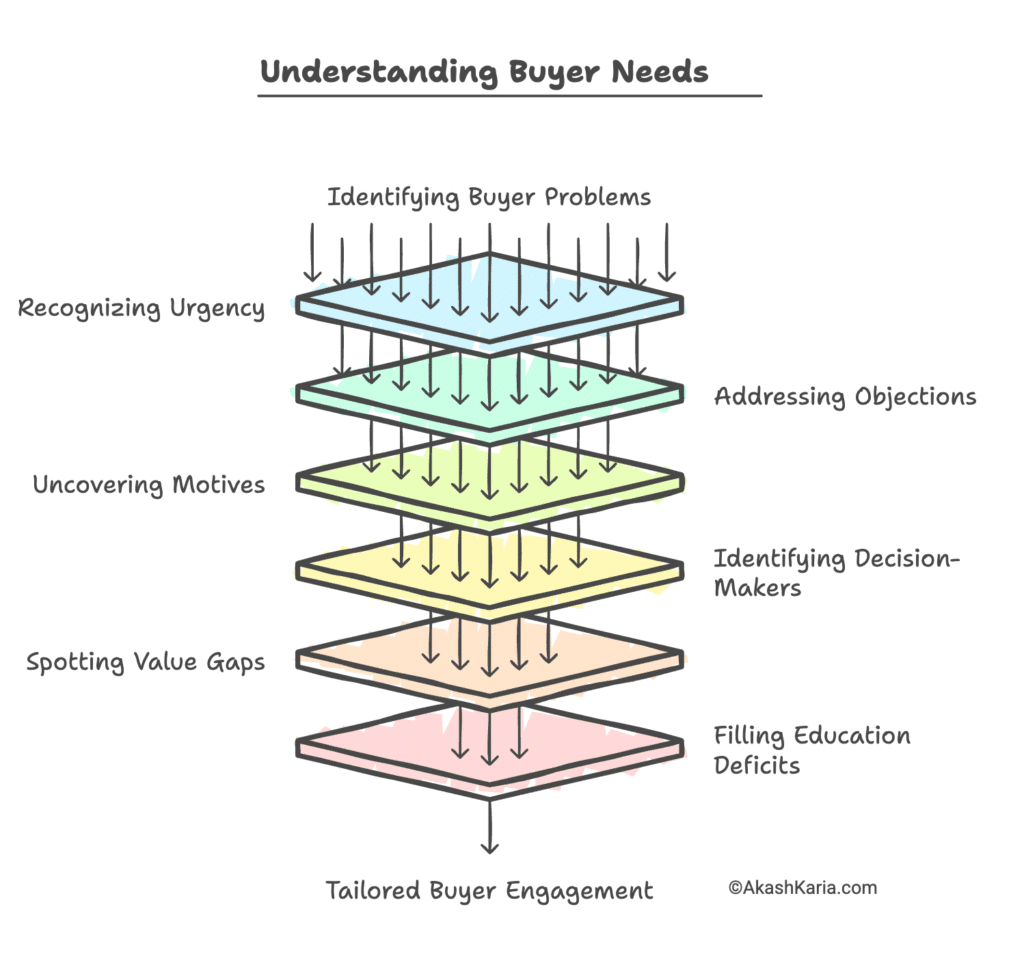
#2. Urgency Analysis: Why Would They Act Now?
Interest without urgency = No deal.
Stakeholders need a reason to move now, not later.
Buyer urgency often comes from external forces – deadlines, competition, or shifting market conditions.
To analyze urgency, you need to consider:
- Do they have upcoming product launches or seasonal campaigns where they need to win?
- Are competitors outpacing them?
- Are new trends (e.g., AI-generated content, short-form dominance) making their current approach outdated?
Action Step: Map out the external and internal forces driving urgency for your stakeholders. Quantify the risk of inaction.
#3. Resistance Mapping: What Objections or Concerns Might They Have?
Even when a solution is great, stakeholders hesitate.
Resistance isn’t just about objections – it’s about competing priorities, internal politics, and personal risks.
To map buyer resistance, analyze:
- Financial Risks – Are they worried about ROI or budget constraints?
- Reputational Risks – Do they fear looking bad if your service underperforms?
- Operational Hurdles – Do they see implementation as too complex or resource-heavy?
- Internal Politics – Are there conflicting agendas or power struggles within their team?
- Competing Priorities – Are they focused on other initiatives that overshadow this?
Once you understand resistance, you can preemptively address concerns and remove friction from the decision-making process.

#4. Hidden Motives Analysis: What Are Their Personal Motives?
Stakeholders have personal motivations beyond business goals.
Uncovering these can be the difference between a closed deal and a stalled one.
- Are they worried about advocating for your software because they lack experience using it?
- Do they need a safe, low-risk way to test your product before committing budget?
- Are they focused only on immediate revenue rather than long-term brand building?
- Do they have false beliefs about your product – things they assume but aren’t actually true?
If you can address their unspoken concerns, you build trust and increase buy-in. And if you can share a personal story that helps them buy into your credibility, that helps even more.
#5. Power Analysis: Who Actually Makes the Decision?
Many sales teams waste time convincing the wrong person. True decision-making power often operates behind the scenes.
Ask yourself:
- Is the person you’re speaking with a recommender, gatekeeper, or ultimate decision-maker?
- Are there competing priorities higher up that might derail this?
- Who needs to be convinced internally for this deal to happen?
A thorough stakeholder analysis ensures you’re engaging the right people, not just the most vocal ones.
#6. Value Gap Analysis: What’s the Blind Spot?
The potential buyer liking your service isn’t enough. They need to see it as essential.
If they haven’t said yes, something is missing in how they perceive its value.
Pinpoint the blind spot:
- Industry Blind Spot – They don’t see how your product applies to their sector. Do they assume their audience isn’t there? Have they overlooked competitors successfully using your service? Are they missing relevant case studies?
- Platform Blind Spot – They misunderstand how your service works. Do they think it’s just for Gen Z? Are they unaware of its targeting capabilities? Do they assume it’s purely for entertainment and not business impact?
- Performance Blind Spot – They don’t see the measurable value. Are they unsure how your service drives ROI? Are they comparing it unfairly to channels with different metrics?
When you bridge the value gap, you eliminate buyer hesitation.
#7. Education Deficit Analysis: What’s Missing?
If a stakeholder lacks clarity, they won’t buy. The real issue isn’t resistance – it’s lack of understanding.
Ask:
- What key insights are they missing that would change their perspective?
- What false assumptions are creating hesitation?
- What additional proof do they need?
- What customer stories can help them understand the value of your solution?
- What training would make them more confident in adopting your solution?
The more you educate, the faster you close deals.
Wrap Up
A buyer needs analysis isn’t just about identifying pain points. It’s about understanding stakeholders holistically – what drives them, what holds them back, and what will finally push them to act.
When you master these seven dimensions of buyer needs analysis, you start pitching your ideas with confidence.
Level Up With Persuasive Sales Training Workshops
My sales communication workshops turn vague pitches into clear, compelling stories that win deals.